


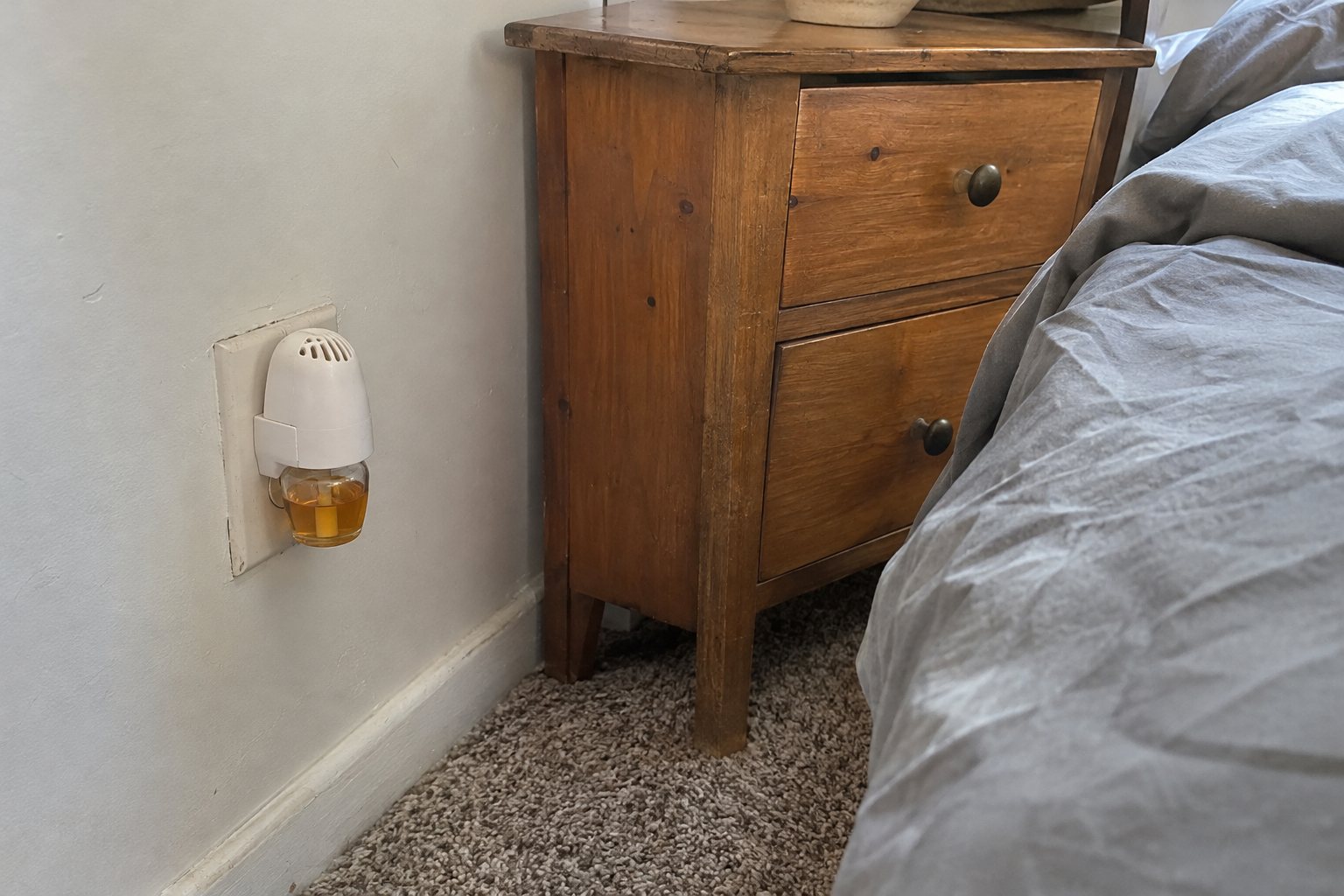

If you run one plug-in at average use in a room with normal fresh air, it adds a small, steady amount of fragrance compounds 1,3. How much it changes the air depends on the number of units, room size and fresh-air exchange 1,3,42.
No regulator has drawn a yes-or-no line for plug-in air fresheners. The United States also has no health-based standard for total VOCs in homes 8.
Germany's health-based precautionary value for limonene is 1,000 µg/m³, far above what one plug-in adds. But limonene is only part of the question. Its ozone products and the home's total load are the more useful comparisons 9. Under reasonable worst-case use in a test bedroom, some products exceeded health reference values 3.
In a US self-report survey, 43.3% of people with asthma reported breathing problems from fragranced products 20. "Every night I was coughing uncontrollably," one TikTok commenter wrote about a plug-in beside the bed, quoted by the Daily Dot 20.
Headaches and coughs are widely reported after a plug-in goes in. Those reports cannot show that the plug-in caused the symptoms 19,20. Across a whole home, one plug-in is seldom the largest source by peak or mass 2,4,11.
If a plug-in concerns you, take it out of the room, not just out of the socket. Removing the home's fragranced products for a while costs nothing. The one label line worth reading is "fragrance-free" 34.
For a household with no asthma, COPD or symptoms, the step that matters most is using fewer units. Keep them out of small, closed rooms. That advice is our inference from how air dilutes 42.
When removal cannot answer the question, the Chemical Testing package ($499) measures the air's volatile organic compound (VOC) load. It sizes fragrance products against building materials, garage fuels and other sources.
Health information on this page is educational. See the disclaimer at the end. Jump to what to do.
Table of contents
- Plug-In Air Fresheners Are One Fragrance Source Among Many in a Home
- Can Plug-In Air Fresheners Cause Headaches or Breathing Problems? Symptoms by Body System
- Why the Label Lists Almost None of What a Plug-In Air Freshener Emits
- Why You Can't Judge Plug-In Air Freshener Levels by Smell
- Do Essential-Oil Diffusers, Candles or "Natural" Air Fresheners Lower the Fragrance Load?
- Do Plug-In Air Fresheners Release Formaldehyde?
- What a Chemical Test Shows About Plug-In Air Fresheners, and What It Doesn't
- What to Do About Plug-In Air Fresheners: Take Scent Out First, Then Measure
- FAQ: Are Febreze, Glade and Air Wick Plug-In Air Fresheners Safe?
- Snapshot: the field as of November 2026
- Plug-In Air Freshener Statistics, Glossary and References
Plug-In Air Fresheners Are One Fragrance Source Among Many in a Home
If you run one plug-in in a well-aired room, a 60-home UK study suggests the rise is hard to detect. Over 72 hours, α-pinene rose only in the least-ventilated quarter of homes 1. α-Pinene is a fragrance compound. Its median rose from about 6 to 14 µg/m³ 1.
Total VOCs across all homes ranged from 30 to over 5,000 µg/m³ 1. A University of York team ran the study with fragrance maker Givaudan and retailer Bath & Body Works. Both companies funded it 1.
At average use, one plug-in in a room with normal fresh air adds a small amount compared with the home's total load. The amount grows with more units, smaller or closed rooms and lower air exchange. 1,3,42 Normal fresh air here means typical-home ventilation, about 0.5 air changes per hour 5.
Average use and reasonable worst-case use produced different results. Researchers tested 15 sprays and diffusers in a 32 m³ French test bedroom. At average use, every product stayed under every health reference value. Under reasonable worst-case use, some exceeded references for acrolein, benzene, formaldehyde, fine particles and limonene 3.
Other scented products can produce larger short bursts. One full-strength pine-oil cleaning job produced 1,000 to 1,100 µg/m³ of d-limonene for an hour in a 50 m³ test room. An air freshener held each main compound at 30 to 160 µg/m³ 4. A brief burst and a steady source are not directly comparable. We found no same-home comparison of the two 41.
When the plug-in becomes the main source in one room
A shut bedroom has less fresh air to dilute a plug-in's emissions. Concentrations rise as ventilation falls 42.
Think of a drop of food coloring: it vanishes in a bathtub and darkens a cup. A shut small room is the cup.
In a bathroom-sized test room, α-pinene rose from about 4 µg/m³ with one diffuser to 25 with five 5. That room was ventilated about 14 times faster than a typical US home. Typical German homes carry a median α-pinene of about 4 µg/m³. Those samples probably include homes with complaints 7.
Against that background, a plug-in can plausibly be the main fragrance source in one room. This conclusion comes from dilution math, not a room measurement 42.
Other scented products in a home, and what has been measured for each
A plug-in is only one fragrance source in a home. The table shows what researchers measured from other sources. It also shows where each appears on IndoorDoctor's sample Chemical Testing report.
| Source | What has been measured | Report category |
|---|---|---|
| Plug-in air freshener | Steady release. An air freshener held 30 to 160 µg/m³ per compound in a test room 4. | Odorants and Fragrances. |
| Scented candle | Combustion adds to evaporated fragrance 12. | Odorants and Fragrances, for the fragrance part. |
| Perfume, body spray, hair spray | Ethanol peaks of 2,000 to 4,000 ppb after use 11. | Personal Care Products, which the report says covers perfumes. |
| Laundry products | Dryer-vent exhaust carried acetaldehyde up to 47 µg/m³. The route into rooms is unmeasured 17. | Personal Care Products, in my experience; the sample report does not name laundry products. |
| Potpourri, cooking spray, nail care, nail-polish remover | Not measured. | Potpourri: Odorants and Fragrances. Nail care: Personal Care Products, which lists "nail care supplies." Cooking spray and nail-polish remover: probably Personal Care Products, in my experience; the sample report does not name either product. |
| Mothballs and naphthalene | A separate source, never attributed to plug-ins. | Moth Balls. |
We found no measurements of what cooking sprays, nail-polish remover or potpourri add to indoor air. Nor has anyone measured how laundry fragrance reaches indoor air.
Chemical Testing sorts a home's VOC load by source category. That shows how fragrance compares with the home's other VOC sources.
Section 02Can Plug-In Air Fresheners Cause Headaches or Breathing Problems? Symptoms by Body System
Headaches and coughs are the symptoms people report most often after a plug-in goes in. One MetaFilter poster described an office visit in 2021: "I went in a client's office in the Before Times and literally had to FLEE because instant migraine. She was very offended and insisted that there was no smell from her plug-ins, they just 'kept the air fresh.'" 21
| Body system | What people report | What the evidence says |
|---|---|---|
| Head | Headache or migraine, often within hours of a fresh refill 19. | Self-report surveys on fragranced products overall: 33% of Australians reported adverse effects and 10.0% migraine (Australian survey). 34.7% of US adults reported adverse effects (US survey) 19. |
| Breathing | Asthma symptoms, night cough, COPD flare-ups 20. | US self-report survey: 43.3% of people with asthma reported respiratory problems from fragranced products 20. California's surveillance program had linked 300+ work-related asthma cases to fragranced products by 2017, counted from case reports, not incidence 29. |
| Eyes, nose, throat and airways | Not commonly reported at home. Possible irritation comes from a chamber measurement. | At about 50 ppb ozone, well above typical indoor levels, a chamber test measured formaldehyde at levels the authors flagged for sensory irritation 6,15. |
These are reports from the people who experienced them. They do not establish that a plug-in caused the symptom in any one case.
Fragrance can trigger symptoms in people who already have asthma or COPD. The evidence here does not show that plug-ins cause asthma or new allergy. California's surveillance program counts almost a quarter of its fragrance-related work asthma cases as new-onset. That figure covers all fragranced products, not plug-ins 29.
If you have asthma or COPD, remove fragrance from the rooms you use. California's health department gives the same advice for workplaces 28. Talk with your clinician about your symptoms. See also our article on headaches and indoor air.
Section 03Why the Label Lists Almost None of What a Plug-In Air Freshener Emits
An ingredient list tells you what goes into the oil. It does not tell you what reaches the room. It also cannot show what forms after those compounds react in the air 13,10.
The counts of compounds emitted by fragranced products come from one research group's laboratory tests of the products themselves, not from measurements of room air. In a 2011 laboratory test, the group examined 25 fragranced products. Of those, 8 were air fresheners. The products emitted 133 VOCs, but only 1 appeared on any label 13.
California expanded what manufacturers must disclose. Since 2020, SB 258 has required air fresheners to disclose fragrance allergens at 0.01% (100 ppm) online; label disclosure followed the next year 30. Large brands now publish fragrance ingredient lists online: SC Johnson for Glade, P&G for Febreze and Reckitt for Air Wick.
The industry's own standards place plug-ins in IFRA Category 12, where fragrance concentration "is not restricted." The reason is "expected negligible skin exposure" 32. Both that standard and the EU allergen list behind SB 258 focus on skin contact, not room air 31,32.
Look for "fragrance-free," not "unscented." FDA says unscented cosmetics may contain fragrance that masks other smells 34. Applying that distinction to air care is our reasoning.
Section 04Why You Can't Judge Plug-In Air Freshener Levels by Smell
A nose that has been away from the room can tell that a scent is present. No nose can measure how much is in the air.
One forum poster described the effect: "after living with them for a while I don't smell them at all, but returning to the same house after being away for some weeks I find them overpowering" 21. Adaptation takes days 21.
In one test, five diffusers raised α-pinene steadily with each added unit, yet perceived strength stopped rising after the second 5,5. The two-unit finding comes from one study in test rooms ventilated far more than a home.
The person who chose the scent is often not the person with symptoms. Reports come from partners, office visitors, neighbors, tenants and coworkers 22. In disputes reported in a newspaper legal column and on forums, nobody proposed measuring the air 22,21.
If you use a plug-in to cover a smell
One UK forum poster wrote in 2010: "our flat has a slight (inherent, unfixable) damp problem and gets a bit musty." 23 People say they run plug-ins to cover damp, mustiness and other lingering smells 23.
California's health department tells employers: "Do not use or allow air fresheners in the workplace. Fix or remove what is causing bad odors." 28
We expect the underlying odor to return after the scent is gone. We found no study that tests this 46. In my experience of IndoorDoctor's inspections, heavily scented homes and moisture or mold findings are unrelated. Treat a musty smell as a separate question. Our Mold Testing package ($399) tests a sampled area for mold. That is one way to check a musty smell.
Do Essential-Oil Diffusers, Candles or "Natural" Air Fresheners Lower the Fragrance Load?
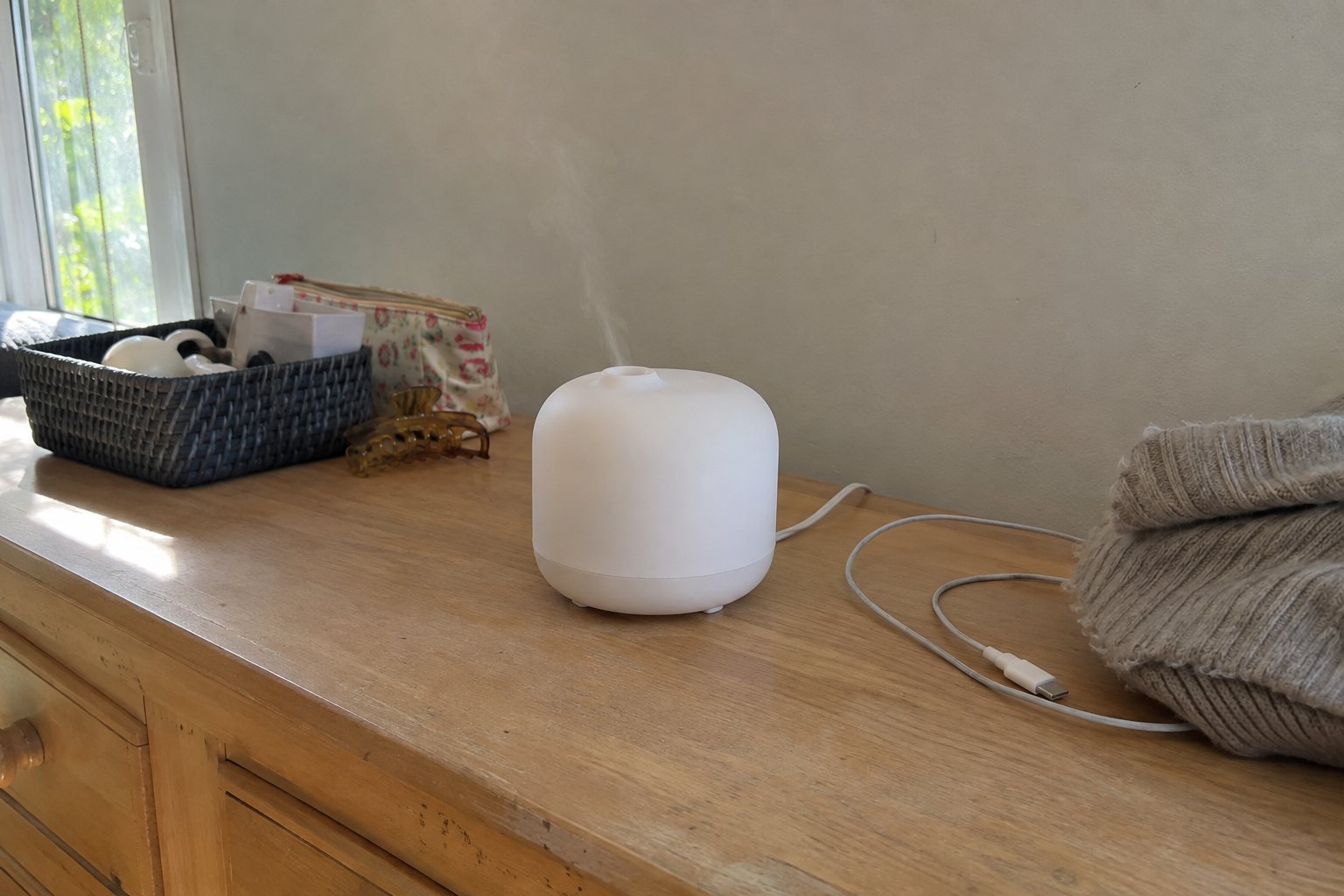
If you replace a plug-in, another scented product does not reliably lower your fragrance load. One Daily Dot commenter wrote: "I use the water diffuser with the essential oil, it cleans the air." 25 Many people who remove a plug-in replace it with another scented product 25.
One health-forum poster described a broader change in 2008: "I got rid of all the air [fresheners], washed all my clothes & bedding in fragrance free soap, no fabric softener. Did not wear perfume, didn't clean with chemicals. Bathed in fragrance free soap and shampoo and was feeling better, headaches were way less." 24 People who report feeling better usually removed several products at once, so these reports cannot show which product mattered.
| Swap | What changes | What stays |
|---|---|---|
| Essential-oil diffuser | Pulsed release plus particles. Tap water raised particle output fivefold 35. | The same terpene class: 2.6 mg of d-limonene in a 15-minute lemon-oil run 35. |
| Scented candle or incense | Combustion adds formaldehyde, soot and fine particles 18,40. | Fragrance still evaporates from the wax 18. |
| "Green" or "natural" product | One research group found no significant difference from regular fragranced products 37. | Terpene emissions 37. |
Candles and incense add combustion to the room. A scented candle snuffed with a lid produced no rise in fine particles. Incense raised them in a closed room 40. We found no study that compared a week of plug-in use with a week of a substitute in the same home. Short diffuser runs with distilled water in a ventilated room give a smaller dose 35.
Don't use an ozone generator or ionizer to clear a scent
An ozone generator bought to clear a scent adds the reactant that turns fragrance terpenes into formaldehyde, as Connecticut's health department notes of plug-ins 38.
At concentrations within public health standards, ozone has little potential to remove indoor air contaminants, according to EPA 38. A small number of tests found negligible-to-mixed VOC removal from ionizing and oxidation-based purifiers. Those tested devices also added oxygenated VOCs 39.
Section 06Do Plug-In Air Fresheners Release Formaldehyde?
A plug-in can contribute to formaldehyde when ozone is present. Its terpenes, including limonene and linalool, react with ozone in the air 14,6.
In a 20 m³ chamber at about 50 ppb ozone, a plug-in produced formaldehyde and other aldehydes. The test also measured a particle peak of 24 µg/m³. At about 5 ppb ozone, particles did not rise 6,6.
Typical indoor ozone is 4 to 6 ppb. Open windows or an ozone-producing air cleaner can raise it 15.
Fragrance compounds form formaldehyde when ozone is present, some products also emit it directly, and building materials usually supply more of it. 6,3,36 Our article on where formaldehyde in a home comes from explains those larger sources. The Chemical Testing report does not include formaldehyde because formaldehyde requires its own testing method. The next section explains what the report does show.
Section 07What a Chemical Test Shows About Plug-In Air Fresheners, and What It Doesn't
If removing scented products has not settled the question, a chemical test shows where fragrance sits among your home's other VOC sources.
Chemical Testing is do-it-with-us. You collect the air sample. Then I or someone from my team reviews the result with you during a Zoom expert consultation. IndoorDoctor's sample report provides:
- Total VOCs in ng/L, set against the lab's distribution of tested homes. One ng/L equals one µg/m³.
- A contamination index by source category. "Odorants and Fragrances" covers "scented candles, potpourri, air fresheners, scented cleaning products, and scented personal care products." Other categories include Personal Care Products, Alcohol Products, Moth Balls and Dry Cleaning Solvents.
In my experience, when several kinds of product release the same compound, such as limonene, the report files it under one category and lists its possible sources beside it.
The report shows fragrance products as one category against the home's other sources. It does not rank one fragrance product against another, and it does not say whether a product is causing symptoms. The sample report also names selected compounds, such as ethanol and acetone, and gives their levels. The Chemical Testing report does not include formaldehyde, and the 2016 sample report does not list it.
There is no U.S. health-based standard for total VOCs in a home. The 500 µg/m³ figure on the report is a building-certification benchmark, not a health line 8,33. The report prints that benchmark as 500 ng/L.
The report plots a home's total VOC reading among homes the lab has tested. It also places the reading in fixed bands the lab sets, such as "Elevated" at 1,500 to 3,000 ng/L. Those band names are the lab's words, not a health grade. Those homes belong to people who chose to test. They may not represent a typical home.
A consumer VOC meter reports one total. It cannot name the source 27. In one evaluation, 87 monitors deviated up to 79% from reference instruments 45. See our article on what a VOC reading means.
Section 08What to Do About Plug-In Air Fresheners: Take Scent Out First, Then Measure
- Remove fragranced products. Include scented cleaners, laundry and personal care. Take units out of the room, not just out of the socket, because two people report scent from units that were not plugged in 21.
- Use fewer units. Use no ozone devices 42,38. Placement advice, such as keeping units out of small closed rooms and nurseries, follows from how air dilution works. We found no study that measured a plug-in beside a bed or crib.
- Ventilate. Fresh air lowers the primary compounds a test reports 42,5. Removing the source beats airing out, because surfaces re-release compounds once the windows close 16.
- Test when removal cannot answer the question. By our reasoning, three cases fit. Your household disagrees about whether there is a problem. Symptoms or odor persist after fragranced products are gone. Or you want to compare fragrance with sources that removing fragranced products does not address, such as an attached garage 43 or a new mattress 44. For that comparison, I advise sampling with plug-ins in use.
The Chemical Testing package costs $499. It includes lab analysis, sampling equipment, shipping and a Zoom expert consultation with me or someone from my team. It also ships nationwide. IndoorDoctor tests only and does not sell remediation.
Common questionsFAQ: Are Febreze, Glade and Air Wick Plug-In Air Fresheners Safe?
Are plug-in air fresheners bad for you?
At average use, one plug-in in a room with normal fresh air adds a small amount of fragrance compounds compared with the home's total load 1,3. More units, a small closed room or a tight winter house raise it 1,5,42. Under reasonable worst-case use in a test bedroom, some products exceeded health reference values 3. The symptoms people report most are headaches and breathing problems. These are self-reports, and they do not establish that a plug-in caused them 19,20.
Are plug-in air fresheners toxic?
What reaches your room depends on the number of units, room size and fresh-air exchange 1,3,42. At average use, one unit adds a small amount of fragrance compounds compared with the home's total load 1,3. Under reasonable worst-case use in a test bedroom, some products exceeded health reference values for acrolein, benzene, formaldehyde, fine particles and limonene 3. Chemical Testing can show where fragrance compounds sit among your home's other VOC sources. It cannot determine whether a product is causing symptoms.
Are Febreze plug-ins safe?
At average use with normal fresh air, one plug-in adds a small amount of fragrance compounds compared with a home's total load. More units or less fresh air raise it 1,3,42. Under worst-case use in one test, some air fresheners exceeded health reference values 3. The studies did not name brands. We are applying their findings to Febreze units. P&G lists the fragrance ingredients for Febreze plug-in refills on SmartLabel, including allergens California requires it to list. That list says what is in the oil, not what reaches your air 13.
Are Glade plug-ins safe?
At average use with normal fresh air, one plug-in adds a small amount of fragrance compounds compared with a home's total load. More units or less fresh air raise it 1,3,42. Under worst-case use in one test, some air fresheners exceeded health reference values 3. The studies did not name brands. We are applying their findings to Glade units. SC Johnson lists the full fragrance ingredients for its Glade PlugIns refills on its What's Inside site and marks the ones on its skin-allergen list. That list describes the oil, not the room air 13.
Are Air Wick plug-ins safe?
At average use with normal fresh air, one plug-in adds a small amount of fragrance compounds compared with a home's total load. More units or less fresh air raise it 1,3,42. Under worst-case use in one test, some air fresheners exceeded health reference values 3. The studies did not name brands. We are applying their findings to Air Wick units. Air Wick's SmartLabel pages name the fragrance components and flag the EU-listed fragrance allergens. That list describes the oil, not the room air 13.
Can plug-in air fresheners cause headaches?
People report headaches with plug-ins, often within hours of a fresh refill 19. These are reports from the people who experienced them. They do not establish that a plug-in caused the symptom in any one case.
Can plug-in air fresheners cause breathing problems?
Fragrance can trigger symptoms in people who already have asthma or COPD 20,28. The evidence here does not show that plug-ins cause asthma or new allergy.
Is it okay to use one in a bedroom or nursery?
A small closed room is where a plug-in is most likely to matter, because it has less air to dilute the scent 42. That is arithmetic about dilution. We found no study that measured a plug-in beside a bed or crib. Many parents keep plug-ins out of the nursery 26.
SnapshotSnapshot: the field as of November 2026
Plug-in air fresheners drew news coverage between October 4 and November 3, 2026, but no new rules or measurements.
What did not happen. We found no recall of a plug-in air freshener, no new federal or state fragrance rule, and no new peer-reviewed plug-in measurement with a confirmed date. Our search may have missed something, so this is not proof that nothing happened.
What did happen.
- A naturopathic doctor's TikTok claim that plug-ins contain formaldehyde and VOCs recirculated in two outlets. The Irish Mirror published it on 2026-10-27 48. Health Chosun followed on 2026-11-01 49. Neither article offers a measurement. The Mirror adds that plug-ins used properly "aren't usually seen as a major health risk" 48.
- Two pulmonologists in the Hindustan Times on 2026-10-16 put frequency and ventilation first 50.
Plug-In Air Freshener Statistics, Glossary and References
Relevant statistics
Every figure links to its source. Survey percentages are self-report. Headspace and chamber figures are not room exposure.
| Statistic | Source |
|---|---|
| One plug-in diffuser, 72 hours, 60 UK homes: α-pinene median rose from about 6 to 14 µg/m³ and the mean from 9 to 14.5, only in the least-ventilated quarter of homes | pubs.rsc.org |
| Total VOCs across those homes: 30 to over 5,000 µg/m³ | pubs.rsc.org |
| 32 m³ French test bedroom, 15 air fresheners: under every health reference value at average use; some exceeded references for acrolein, benzene, formaldehyde, PM2.5 and limonene at reasonable worst-case use | doi.org/10.1111/ina.12923 |
| One pine-oil cleaning job: 1-hour d-limonene of 1,000 to 1,100 µg/m³; an air freshener held each main compound at 30 to 160 µg/m³ (50 m³ room, about 0.5 air changes per hour) | pubmed.ncbi.nlm.nih.gov/16683937/ |
| Perfume, body spray and hair spray: ethanol 2,000 to 4,000 ppb right after use | pubs.acs.org |
| Five diffusers in a bathroom-sized test room: α-pinene about 4 µg/m³ with one unit to 25 with five. Perceived strength plateaued after two units. Test rooms ran at 7.5 air changes per hour, about 14 times the US residential geometric mean of 0.53 | pubs.rsc.org |
| Median d-limonene in US-type residences, from 6 of 77 compiled studies: about 9.5 µg/m³. German homes: median α-pinene about 4 µg/m³, from samples that probably include homes with complaints | osti.gov/servlets/purl/985323 ; agoef.de |
| Limonene health-based guide values: 1,000 to 10,000 µg/m³ (German RW I 1 mg/m³; EU-LCI 5,000 µg/m³) | umweltbundesamt.de |
| 2011 laboratory test, 25 fragranced products (8 air fresheners): 133 VOCs, 1 on any label | doi.org/10.1016/j.eiar.2010.08.002 |
| Plug-in in a 20 m³ chamber: particle peak 24 µg/m³ at about 50 ppb ozone; no particle increase at about 5 ppb | pubmed.ncbi.nlm.nih.gov/24769411/ |
| Typical indoor ozone: 4 to 6 ppb | doi.org/10.1111/ina.12942 |
| Self-report: 33% of Australians report adverse effects from fragranced products, 10.0% migraine; 34.7% of US adults report adverse effects | sciencedirect.com (Australia); pubmed.ncbi.nlm.nih.gov/27867426/ (US) |
| Self-report: 43.3% of US adults with asthma report respiratory problems from fragranced products | portfolio.jcu.edu.au/Publications/JCU161722 |
| More than 300 California work-related asthma cases associated with fragranced products by 2017 (case reports, not incidence); almost a quarter of fragrance cases new-onset, for fragranced products as a group | stacks.cdc.gov/view/cdc/223839 |
| Attached-garage sources: an estimated 40 to 65 percent of indoor benzene exposure | canada.ca |
| 87 consumer monitors: total-VOC readings deviated up to 79% from reference instruments | doi.org/10.3390/buildings14092965 |
| Lemon-oil ultrasonic diffuser, 15 minutes: 2.6 mg d-limonene; tap water raised PM1 emission fivefold | onlinelibrary.wiley.com/doi/10.1111/ina.12845 |
| IFRA Category 12 (plug-ins): fragrance concentration "not restricted" | d3t14p1xronwr0.cloudfront.net |
| California SB 258: allergen disclosure at 0.01% (100 ppm); online 2020, labels 2021 | legiscan.com/CA/text/SB258/id/1653091 |
Glossary
- VOC (volatile organic compound)
- a carbon-based chemical that evaporates into room air from products and materials.
- Total VOCs (TVOC)
- the sum of the VOCs a test measures. It adds compounds that differ widely in how they act, so the sum carries no health threshold.
- µg/m³ and ng/L
- units of concentration. One ng/L equals one µg/m³.
- ppb (parts per billion)
- a count of molecules of one gas per billion molecules of air.
- Air changes per hour
- how many times the air in a room is replaced by outside air each hour. Lower numbers mean less dilution.
- Terpene
- a plant-derived fragrance compound, or a close relative, such as limonene, α-pinene or linalool.
- Limonene
- the main fragrance terpene in citrus scents, cleaners and many plug-ins.
- Ozone
- a reactive gas that mostly enters homes from outdoors. Some air cleaners also make it. It reacts with terpenes.
- Headspace test
- a laboratory test of the vapor above a product in a sealed container. It shows what a product emits and does not show what a room contains.
- Fragrance-free and unscented
- "fragrance-free" means no fragrance added. "Unscented" can still contain fragrance that masks other smells.
- IFRA
- the International Fragrance Association, whose standards are voluntary for non-members.
- SB 258
- California's Cleaning Product Right to Know Act of 2017, which reaches air fresheners.
- Odorants and Fragrances
- one source category on the Chemical Testing report's contamination index.
References and citations
| # | Source |
|---|---|
| 1 | Warburton et al., Environ Sci: Processes Impacts, "The impact of plug-in fragrance diffusers on residential indoor VOC concentrations" Peer-reviewed, 60 UK homes. University of York; funded by Givaudan and Bath & Body Works. · 2023 · Plug-in increment against home-to-home spread pubs.rsc.org |
| 2 | Heeley-Hill et al., Environ Sci: Processes Impacts Peer-reviewed · 2021 · Whole-home VOC sources pubs.rsc.org |
| 3 | Karr et al., Indoor Air Peer-reviewed, test house · 2021 · Average-use and worst-case results doi.org/10.1111/ina.12923 |
| 4 | Singer et al., Indoor Air Peer-reviewed, room experiment · 2006 · Air freshener against cleaning bursts pubmed.ncbi.nlm.nih.gov/16683937/ |
| 5 | "An assessment of VOC emissions and human strength perception of liquid electric fragrance diffusers," Environ Sci: Advances Peer-reviewed · 2025 · Unit count, perception plateau, steady emission pubs.rsc.org |
| 6 | Nørgaard et al., Environ Int Peer-reviewed, chamber · 2014 · Ozone condition for formaldehyde and particles pubmed.ncbi.nlm.nih.gov/24769411/ |
| 7 | Logue et al., Indoor Air (LBNL-3650E); AGÖF guidance values Compilation of 77 studies; German indoor-air guidance · 2011; 2013 · Typical limonene and α-pinene osti.gov/servlets/purl/985323 |
| 8 | US EPA, Indoor Air Pollution: An Introduction for Health Professionals Government · n.d. · No federal standard for home indoor air epa.gov |
| 9 | German Federal Environment Agency, limonene guide values Government · n.d. · Health-based limonene guide values umweltbundesamt.de |
| 10 | Steinemann, Air Qual Atmos Health Peer-reviewed, headspace tests · 2015 · Emissions undisclosed; fragrance-free versions lacked terpenes researchonline.jcu.edu.au/43980/ |
| 11 | Wu et al., Environ Sci Technol Lett Peer-reviewed, chamber · 2024 · Personal-care bursts pubs.acs.org |
| 12 | Andersen et al., Indoor Air Peer-reviewed, chamber · 2021 · Candles add combustion products onlinelibrary.wiley.com/doi/full/10.1111/ina.12909 |
| 13 | Steinemann et al., Environ Impact Assess Rev Peer-reviewed, headspace tests · 2011 · Label disclosed 1 of 133 compounds doi.org/10.1016/j.eiar.2010.08.002 |
| 14 | Weschler, Indoor Air Peer-reviewed review · 2000 · Terpene-ozone chemistry doi.org |
| 15 | Nazaroff and Weschler, Indoor Air Peer-reviewed review · 2021 · Indoor ozone 4 to 6 ppb doi.org/10.1111/ina.12942 |
| 16 | Wang et al., HOMEChem measurements Peer-reviewed, test house · 2020 · Surfaces re-release compounds pmc.ncbi.nlm.nih.gov/articles/PMC7030931/ |
| 17 | Steinemann et al., dryer-vent sampling Peer-reviewed, 2 homes · 2013 · Laundry exhaust vents outdoors hero.epa.gov/reference/1610644/ |
| 18 | Candle emission chamber studies Peer-reviewed abstracts · 2021 · Candles add combustion route pubmed.ncbi.nlm.nih.gov/33964641/ |
| 19 | Daily Dot; Steinemann surveys of Australian and US adults News; peer-reviewed surveys · 2016 to 2025 · Headache reports; survey percentages dailydot.com ; sciencedirect.com ; pubmed.ncbi.nlm.nih.gov/27867426/ |
| 20 | James Cook University publication record (US survey); Daily Dot, quoted TikTok comment Survey abstract; news · n.d.; 2025 · Asthma respiratory reports; bedside cough report portfolio.jcu.edu.au/Publications/JCU161722 ; dailydot.com |
| 21 | MetaFilter, "Why Don't Plug-In Air Fresheners Work in My Home Any More" Forum thread · 2021 · Adaptation; unmeasured disputes; office migraine report; unplugged scent ask.metafilter.com |
| 22 | Star Tribune, Renting and the Law Newspaper column · 2016 · Reports from non-owners startribune.com |
| 23 | Singletrack World forum Forum thread · 2010 · Masking a damp smell singletrackworld.com |
| 24 | NeuroTalk forum Forum post · 2008 · Whole-set removal neurotalk.org/268200-post10.html |
| 25 | Daily Dot; forum threads on switching scents News; forum threads · 2025 · People swap to other fragrance sources dailydot.com |
| 26 | Mumsnet thread Forum thread · 2017 · Parents avoid nursery use mumsnet.com |
| 27 | Awair support, Managing Chemicals Vendor documentation · n.d. · Meters report a lumped total support.getawair.com |
| 28 | California Department of Public Health, fragrances employer sheet Government · n.d. · Remove air fresheners; fix the odor source cdph.ca.gov |
| 29 | CDPH and NIOSH, Occupational Health Watch Government · 2017 · Work-related asthma cases stacks.cdc.gov/view/cdc/223839 |
| 30 | California SB 258 chaptered text Statute · 2017 · Allergen disclosure legiscan.com/CA/text/SB258/id/1653091 |
| 31 | European Commission, fragrance allergen labelling Government · 2023 · Skin-allergy basis single-market-economy.ec.europa.eu |
| 32 | IFRA 51st Amendment guidance Industry standard · n.d. · Category 12 rationale d3t14p1xronwr0.cloudfront.net |
| 33 | WELL Building Standard, air quality Certification standard · n.d. · 500 µg/m³ is a building target standard.wellcertified.com/air/air-quality-standards |
| 34 | FDA, Fragrances in Cosmetics Government · n.d. · Jurisdiction; "unscented" caveat fda.gov |
| 35 | Schwartz-Narbonne et al., Indoor Air Peer-reviewed, chamber · 2021 · Diffuser swap onlinelibrary.wiley.com/doi/10.1111/ina.12845 |
| 36 | Lawrence Berkeley National Laboratory, indoor chemical reactions Government laboratory · n.d. · Building materials usually supply more formaldehyde iaqscience.lbl.gov |
| 37 | Steinemann, Air Qual Atmos Health Peer-reviewed review · 2020 · Green versus regular products link.springer.com |
| 38 | US EPA, Ozone Generators That Are Sold as Air Cleaners; Connecticut Department of Public Health, ozone generator fact sheet Government · n.d. · Ozone generators epa.gov ; portal.ct.gov |
| 39 | Zeng et al., Building and Environment Peer-reviewed, device test · 2021 · Ionizers add oxygenated VOCs doi.org |
| 40 | Park et al., J Environ Health Sci Peer-reviewed, closed room · 2024 · Candle and incense particles doi.org/10.5668/jehs.2024.50.1.36 |
| 41 | Patra et al., ACS ES&T Air Peer-reviewed, test house · 2024 · Spray and cleaner bursts doi.org/10.1021/acsestair.4c00118 |
| 42 | Lawrence Berkeley National Laboratory, nine-home ventilation study Government laboratory report, field · n.d. · Concentration inversely tracks air exchange osti.gov/servlets/purl/1169482 |
| 43 | Health Canada, benzene in residential air Government · n.d. · Garage benzene canada.ca |
| 44 | Boor et al., Environ Sci Technol Peer-reviewed, chamber · 2014 · New mattresses emit limonene and linalool pubs.acs.org |
| 45 | Manu and Rysanek, Buildings Peer-reviewed, 87 monitors · 2024 · Consumer meter accuracy doi.org/10.3390/buildings14092965 |
| 46 | New York State Department of Health, odor guidance Government · n.d. · Fresheners mask odors health.ny.gov/publications/6500/ |
| 47 | SC Johnson What's Inside (Glade PlugIns refill); P&G fragrance ingredients policy and Febreze SmartLabel; Air Wick SmartLabel Manufacturer disclosure pages · current · Brands publish fragrance ingredient lists online whatsinsidescjohnson.com ; us.pg.com/fragrance-ingredients-list/ ; smartlabel.pg.com/00030772070710 ; vestacyinfo.com/smart-label.php |
| 48 | Irish Mirror News · 2026-10-27 · Snapshot irishmirror.ie |
| 49 | Health Chosun (English) News · 2026-11-01 · Snapshot health.chosun.com |
| 50 | Hindustan Times News · 2026-10-16 · Snapshot hindustantimes.com |
Package facts in the article come from IndoorDoctor's sample Chemical Testing report and the live product page (indoordoctor.com/product/8521/
About the author. Jeff Bradley founded IndoorDoctor in 2009 in Derry, NH. The company has completed more than 30,000 inspections.