


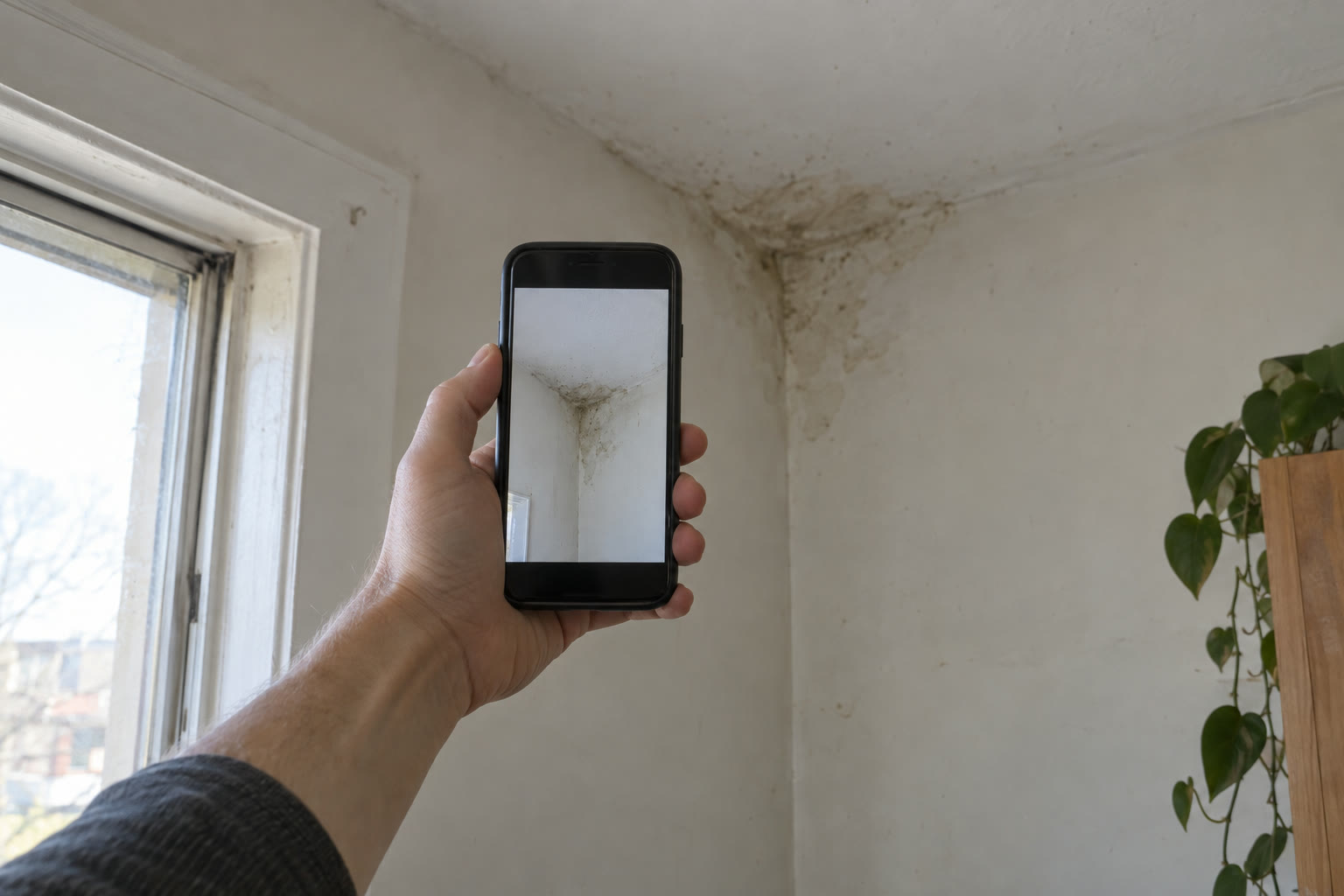


You reported the problem. Someone came, looked, and told you there's nothing there. Maybe they said it was dust. Maybe they said it was paint. Maybe they said you don't ventilate enough. And now you are holding photos, a text thread, and a growing suspicion that you are the only person in this situation who thinks something is wrong.
This article is not going to tell you that you are right. It can't — nobody who hasn't measured your air can. What it will do is show you how to prove mold to a landlord who says there is none: why the evidence you currently hold is easy to wave off, what kind of evidence isn't, and how to produce the second kind without your landlord's cooperation.
One thing to be clear about at the start, because it shapes everything below. A mold report does not declare your home unsafe. No report from any provider does, and no regulatory standard supports one that claims to. What a report does is convert a contested opinion into a documented fact — a named organism, at a stated concentration, measured against a control, with a paper trail attached. That is a smaller claim than "my home is dangerous" and a more useful one, because the systems that can compel a landlord to act — code enforcement, boards of health, housing courts, tenant legal aid, insurers — respond to documented facts and ignore contested opinions.
If you are here because you have not felt well in months, that is the most common reason renters reach this point, and there is a section below on what the symptom pattern actually looks like in the research.
Table of Contents
- What the dismissal actually sounds like
- When your landlord won't fix mold: why "there's no mold" works — and the part you can answer
- What makes tenant mold documentation hold up anywhere: independence, methodology, specificity
- The comparison that turns a number into a finding
- What specificity costs your landlord
- Independent mold inspection in a rental, when the landlord controls the door
- What's actually in the report — and how the Mold Testing Package works
- What the consultation will and won't tell you
- Where the report goes first — and why the free official call shouldn't come first
- What your state's system will do with your documentation
- Three places renters get stuck, and how to get past each
- Symptoms renters report when mold levels are elevated
- Frequently asked questions
- Resources
Section 01
What the dismissal actually sounds like
There is a particular version of this conversation that comes up again and again in renter forums, and it goes about the same way every time.
"Told the company that owns my apartment and they sent a maintenance guy up who confidently said 'NO mold, only' and when I grilled him on details… he replied 'Well I'm no expert'. I just felt defeated and let it go."
— r/ToxicMoldExposureBoth halves are worth sitting with. Someone stated a conclusion with confidence and, when pressed, disclaimed the qualification to have reached it. The renter's response was not to argue. It was to feel defeated and stop.
That reaction is the part that matters, because the dismissal rarely arrives alone. In the threads we reviewed it usually comes paired with an explanation that puts the problem on the tenant: you don't clean enough, your furniture blocks the vent, you keep it too humid in here. A maintenance disagreement turns into a question about your judgment, and after a few rounds most people start auditing their own perception instead of the apartment.
Your perception is not the unreliable part here. In the 2023 American Housing Survey, about 3.9 million of 133.2 million occupied U.S. households reported mold in the previous twelve months — roughly 3 percent 14. Research cited by NIOSH puts the share of U.S. residential buildings showing visible mold or a detectable mold odor at nearly 47 percent 17. Those numbers measure different things, and the distance between them is not a survey error. It is the distance between what people notice and what is present in the building stock.
Section 02
When your landlord won't fix mold: why "there's no mold" works — and the part you can answer
Not everything you have been told is an argument. "You don't clean enough" is not a claim about evidence, and neither is duct-taping a window. Those are ways of ending a conversation, and no amount of documentation answers them directly, because they were never about documentation in the first place.
Set those aside. What's left is the half you can do something about — and it is worth seeing that half at full strength, in the venue where these disputes end up when they escalate.
In Cornell v. 360 W. 51st St. Realty, the New York Court of Appeals let a dismissal stand. The trial judge had concluded that the tenant "did not identify the specific type of molds or toxins that allegedly adversely affected her, and did not quantify her exposure." Her expert had described the problem as "an unusual mixture of atypical microbial contaminants" and made no effort to quantify the exposure 1. In Liese v. Hennessey, expert testimony was excluded for an "analytical gap between the data and the opinion proffered" 2. In Fraser, the plaintiffs "failed to offer reliable measurement of mold levels," and the measurement they did offer "did not meet the standard of reliability" 3.
Strip those holdings down and they say three things: you can't say what it is, you can't say how much of it there is, and you can't say how you know.
Nobody was conducting an admissibility analysis at your kitchen door. But the gaps those rulings name are real gaps, and right now your evidence has all three. Photographs cannot distinguish mold from soot, dirt, mildew, or staining. Keep them — even litigation guidance that calls visual evidence a powerful tool treats a professional inspection with laboratory analysis as the part that carries a case 36 — but a photograph names no organism and quantifies nothing, which is the exact gap that decided Cornell 1. A hardware-store petri dish grows something in nearly any home and produces no chain of custody, no accredited-lab analysis, no species identification, no expert interpretation 32. Symptoms do not name an organism.
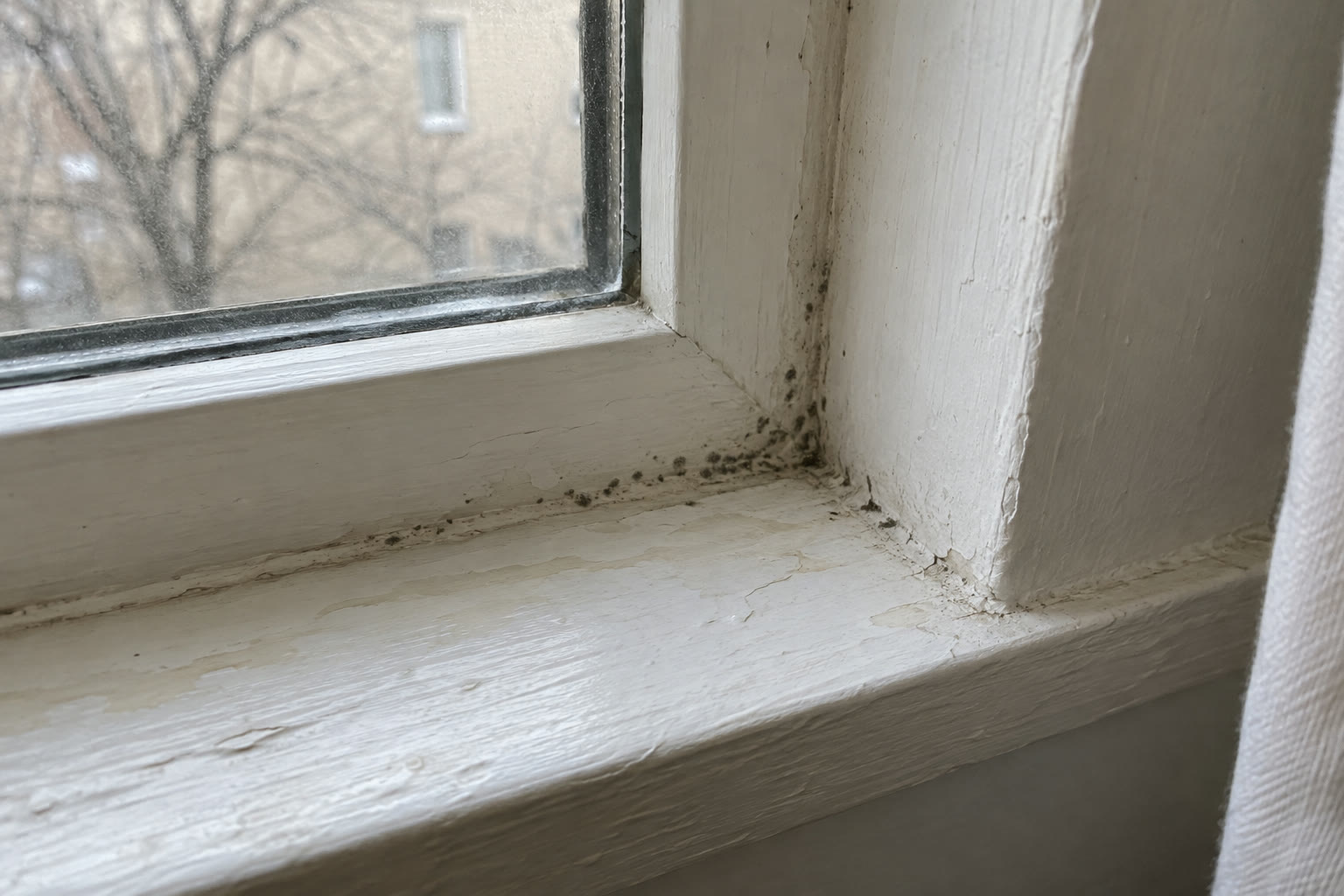
The useful consequence of looking at it this way: you do not need to prove that anyone lied to you. Intent is unprovable, irrelevant to whether a unit is habitable, and pursuing it pushes you into an accusatory register that reads badly in every forum this is headed to. Most "there's no mold here" statements are, at their most generous reading, "no mold I noticed." Visual inspection is the single signal most likely to be wrong on its own 46. That makes the dismissal a statement about one person's eyes on one afternoon, not about your air.
You do not need your landlord to admit anything. You need a document that makes the question answerable without them.
Section 03
What makes tenant mold documentation hold up anywhere: independence, methodology, specificity
Across every domain where a private party has to convince an institution of something the opposing party denies — construction defect, workers' compensation, insurance appraisal, environmental enforcement, custody evaluation — the documentation that works has the same three properties. This is a standard you can apply to any product or service you are considering, including this one.
Methodology comes first, because it is what actually gets litigated. Chain of custody is repeatedly described as the procedure that decides admissibility: any break in it can invalidate samples as evidence 28. Accredited-lab analysis, a published sampling standard, and a documented handling trail are what make a result something other than a number somebody typed. Every one of the mold cases above was decided on this ground or the next one.
Specificity is second. A named organism at a stated concentration in a named location leaves a narrow set of responses available. A vague characterization leaves every response available, which is exactly what sank Cornell's expert 1.
Independence closes the list, and it closes it for a reason. Notice what is not in the case record: not one of Cornell, Liese, or Fraser turned on conflict of interest 123. Independence keeps a report from being set aside as an interested party's document. It is necessary, and it is not what makes a report persuasive. The workers' compensation literature is blunt about why only the structural version counts: independent medical examiners paid by insurers are widely believed to tilt toward insurers, which is a payment-relationship problem rather than a sincerity problem 30. Aspirational independence is a claim; structural independence is an arrangement. In mold, the arrangement is a tester who does not sell remediation — a separation fourteen states, Florida and Texas among them, have written into mold-assessor licensing law rather than leaving to professional courtesy 33. Florida bars an assessor from remediating a structure its company assessed in the previous twelve months, with a narrow contractor exception 39; Texas bars a single license holder, or any common owner, from doing both on one project 40.
Ordinary people have met this standard from a standing start. In 1995, an attorney who fell ill from refinery fumes was told by environmental authorities that their monitors detected no problem. He hired an engineer to build a cheap alternative, and the result was the bucket sampler — an inexpensive plastic-bucket air sampler paired with accredited-lab analysis and a chain-of-custody protocol. Agencies were initially dismissive. In 1996 the campaign's organizer asked EPA Region 9 to evaluate the method; Region 9 funded a quality-assurance review and accepted the results. The first Mossville samples found benzene at many times the state standard, and Region 6 sent its own monitors, which confirmed even higher levels 29.
The scale is not comparable — that was a community producing a pattern; you are one household producing one measurement. The mechanism transfers exactly, though: your sample's job is to trigger the next official look, and the convergence between your evidence and theirs is what moves the conversation.
Section 04
The comparison that turns a number into a finding
Here is the part that decides whether any of the above produces anything usable, and it is a decision you make before a single sample is collected.
Mold spores are in the air everywhere, indoors and out, all the time. So a single indoor number — 1,400 spores per cubic meter, say — is not a finding. It is an adjective. The obvious reply is mold is in the air everywhere, and that reply is correct, which is why single air samples without an outdoor control are close to useless as evidence 468.
What converts a number into a finding is a comparison: a second sample, taken outdoors, at the same address, on the same day, by the same protocol. Now the indoor result has something to be measured against, and elevated compared to the outdoor control means something specific instead of functioning as a hedge. Accreditation vouches for the laboratory; it says nothing about whether this sample, from this unit, on this day, means anything. The control does that, and arranging it is entirely in your hands.
How to allocate the three samples. The Mold Testing Package includes three samples. The configuration that serves a renter in a dispute is two indoor and one outdoor: your worst-suspected location, a comparison room inside the unit, and one outdoor control. That is an allocation of samples you have already paid for, not an add-on purchase.
State the tradeoff honestly, because it is real: electing the outdoor control means you get two indoor locations, not three. If you are chasing a problem across several rooms, that is a genuine cost. Additional samples run $80 each, billed to the card on file — a rule disclosed in writing on the chain-of-custody document you receive with the package and again by separate email, specifically so that nobody runs every cassette in the box and discovers the charge afterward.
Where to ask for it. Do not go looking for an outdoor-baseline checkbox on the product page. There isn't one. The package includes a live Zoom consultation with an IndoorDoctor expert while you take your samples — that call is where sampling strategy actually gets decided. Say, on that call, that you are documenting a dispute with a landlord and you want one of your three samples to be an outdoor control. That is the whole instruction.
One documented exception: if there is deep snow on the ground, ambient outdoor spore levels are low enough that the comparison can be reasoned about without a separate outdoor sample. Raise it on the call and they will tell you.
A scheduling fact. Same-day and same-address means there is no retroactive version of this measurement. Once you move out, the comparison that would have documented the unit's condition while you lived in it no longer exists — renters who leave without capturing it routinely find they have the complaint and nothing to substantiate it. If you are weighing testing before or after a move, that is the fact that decides it.
Section 05
What specificity costs your landlord
There is a question most people in your position are thinking and not asking: fine, I get a report — and then he hires his own guy who says there's no mold, and I'm out $399 and back where I started.
The honest answer is not a prediction about who wins. It is about what your report costs him to answer.
Consider the mirror case. When a landlord produces an all-clear from an inspector he arranged and the tenant contests it with observations and a home-kit result, the professional opinion controls. That is the pattern practitioners describe rather than a rate anyone has measured: the tenants who change that outcome commission an independent counter-inspection, because that creates a genuine dispute of fact rather than a disagreement between a document and a feeling.
Run that mechanism in your direction. A quick visual walk-through by a preferred vendor is a complete answer to "I think there's mold." It costs him a favor, and it wins. It is not an answer to three sealed samples under a custody log, analyzed by an accredited laboratory, with an organism identified at a stated concentration against an outdoor control taken the same day. Nobody rebuts that by walking through a room. Answering it means matching it — same protocol, accredited lab, chain of custody, a comparison of his own — at which point he is not offering an opinion. He is taking a measurement, of the same physical reality, in the same unit.
Specificity does not compel anyone to agree with you. It makes the cheap form of disagreeing unavailable, and it converts the second opinion you are afraid of into a second measurement. How those second measurements come back, we are not going to tell you. Nobody has that data.
On which: we can't tell you the win-rate-with-versus-without independent testing — those numbers aren't centrally tracked in any state. What we can tell you is which forms of documentation housing courts, boards of health, and tenant legal aid organizations consistently treat as adequate, and which they routinely dismiss. That is the whole of what the evidence supports, and every article implying more is implying it without a source.
Section 06
Independent mold inspection in a rental, when the landlord controls the door
The standard advice at this point is to hire a professional inspector. For a homeowner, that is straightforward. For a renter, it sometimes runs into this:
"I scheduled code enforcement to come out to see the property. They arrived today just to say they cant legally do anything until a third party inspector sees the property. I reached out to the third party inspectors and I have been told that renters cannot allow inspectors into a property without the landlords permission."
— r/Renters (Texas)One renter's report, not a legal rule — tenants in possession generally do have the right to admit people, and how inspection firms handle tenant-authorized entry varies by firm and by state. But renters run into this, and the loop it describes is closed at both ends by the same person.
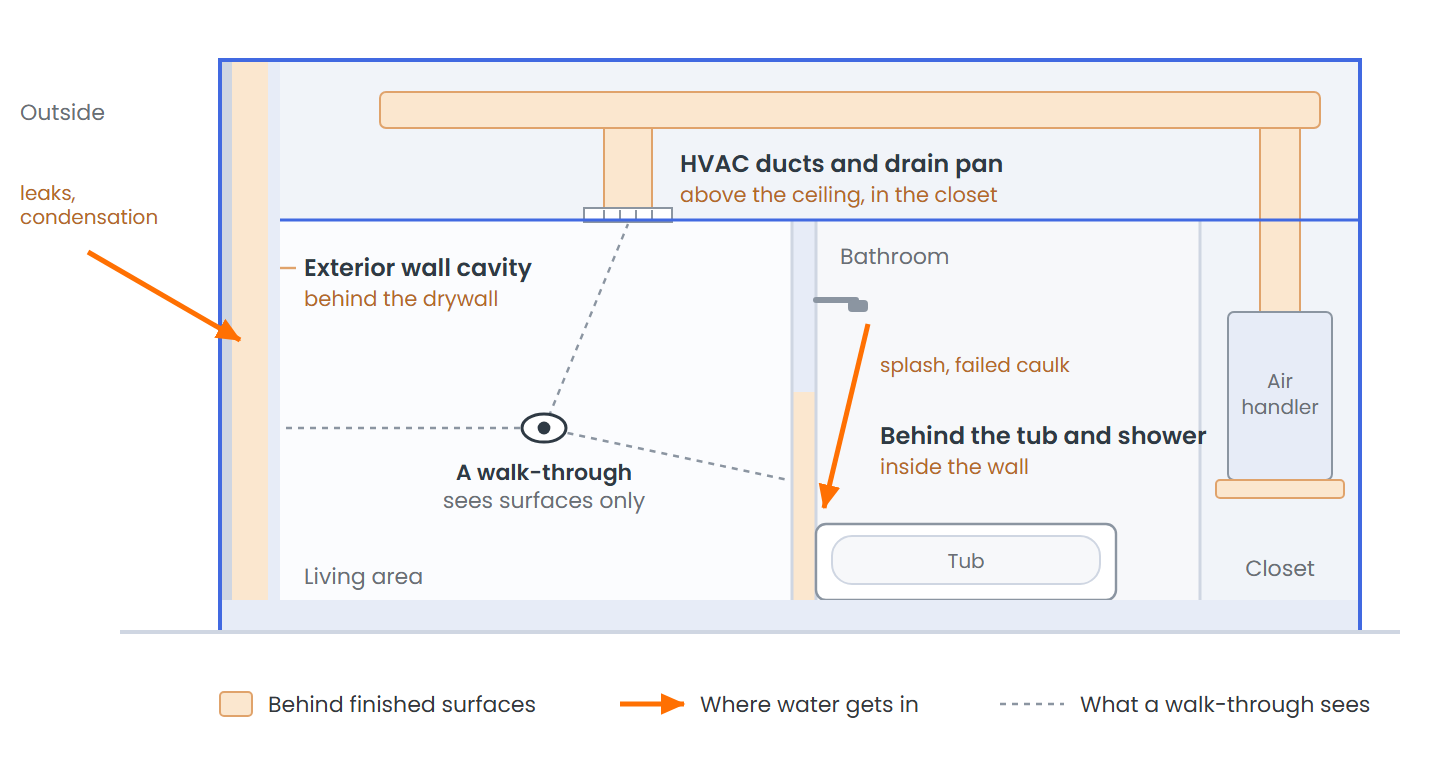
It bites hardest on HVAC. When the suspected source is inside the air handler, the ductwork, or the AC closet, there is nothing for anyone to look at. The maintenance person glances at a grille, sees a grille, says dust. A sample taken at the supply register measures what the system is actually delivering into the room — and that is a sample you can take yourself, without anyone's cooperation.
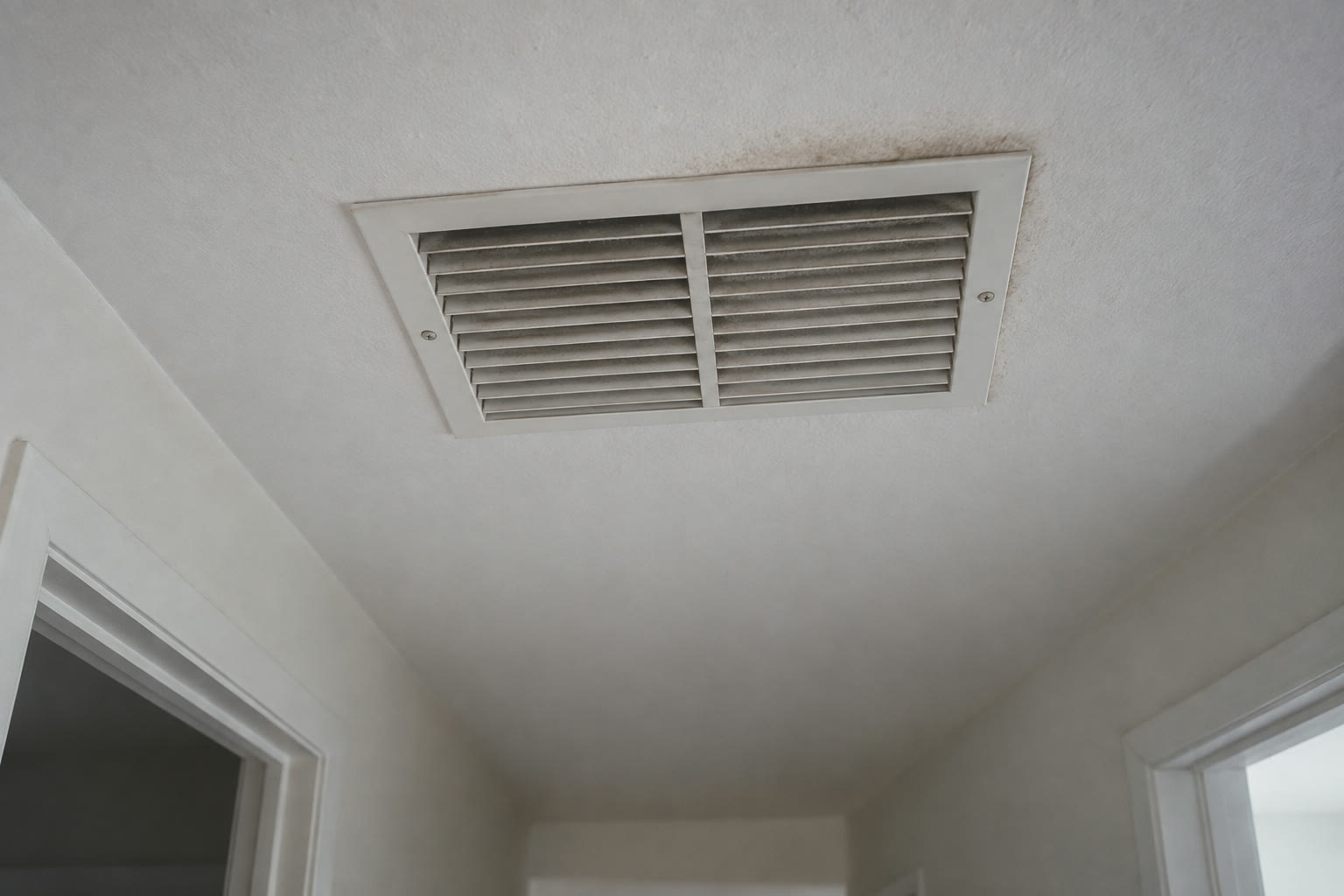
None of this makes in-person inspection inferior. Multi-method on-site assessment by a trained professional — visual, surface, air, and where warranted wall-cavity sampling — is the standard of practice 35, and where you can get one, get one; the average U.S. professional mold inspection runs about $670, range $303 to $1,043 31. The point is narrower and applies to a specific subset of readers. When the person deciding whether an inspector gets through the door is the same person who says there is nothing to inspect, the in-person route is not the premium option. It is the one that isn't on the menu, and the comparison you are actually making is not at-home testing versus in-person. It is at-home testing versus nothing.
Section 07
What's actually in the report — and how the Mold Testing Package works
"What actually happens during a mold inspection? What do inspectors usually test for? What counts as 'above standard'?"
— r/ToxicMoldExposureThose questions come up constantly, and not knowing the answers is its own barrier — it is hard to spend $399 on a black box. Here is what is in it.
How the Mold Testing Package works
- The equipment ships to you. Professional-grade sampling equipment — the same class used on in-person inspections — arrives with a prepaid overnight FedEx envelope for the return trip.
- You collect the samples on a live Zoom call with an IndoorDoctor expert. Three samples, air or surface. This is the call where you say you are documenting a landlord dispute and want one of the three to be an outdoor control (see above).
- Chain of custody travels with the samples. Sealed samples, a custody log, and a lab receipt, packaged with the report. This is the piece that makes the result a record rather than a number.
- An accredited laboratory analyzes them. Labs IndoorDoctor uses include EMSL Analytical, Hays Microbial, and Enthalpy, to name a few — different laboratories for different analyses rather than a single contract lab. The laboratories used carry AIHA and NVLAP accreditation.
- You get a written report and a second Zoom consultation. Results in two to five business days. The lab reports mold by genus and, potentially, to species level as well — potentially both, depending on the organism and the sample. Species-level identification is not guaranteed on every sample, and any provider who guarantees it is overstating what a lab can promise.
If what you need is to know you're not imagining it, this is the wrong purchase
Worth saying plainly, because it decides whether the rest of this is right for you.
If what you need right now is to know you are not making this up — that something really is growing in there — a cheap hardware-store kit will answer that, and you were not wrong to buy one. What it will not do is survive the next conversation, for four cumulative reasons: no chain of custody, no accredited lab, no species identification, no expert interpretation 32. Those are not quality complaints about the kit. They are the four things the next reader of your evidence looks for.
If you have reached the point where somebody else has to act — a landlord, an inspector, a lawyer, an insurance carrier — that is a different purchase.
Your results can come back not elevated, and that is worth knowing now
A real possible outcome of this test is that your indoor samples come back at or below the outdoor control.
That does not mean nothing is wrong, and it does not mean you imagined it. Air, surface, and visible-growth samples answer different questions and do not predict one another; a not-elevated air result does not rule out mold in a wall cavity, under flooring, or inside the HVAC system 456. It redirects the search — toward hidden cavities, the mechanical system, or a non-mold irritant — instead of closing it. That is worth knowing before you spend months building a claim that will not hold.
One caution, from a single renter's account rather than a pattern: at least one landlord agreed to third-party testing while stating the deposit would be kept if results came back below standard. Decide what you will do with either result before you buy.
The Mold Testing Package
Professional-grade sampling equipment, prepaid overnight shipping both ways, accredited-lab analysis, a written report with next-step recommendations, and live Zoom expert consultation while you sample and again after your results. All-inclusive at $399; the package ships nationwide.
Section 08
What the consultation will and won't tell you
On your results call, an IndoorDoctor expert will explain what was measured, how the samples were collected, what organisms the lab identified, and what "elevated compared to the outdoor control" means in your specific numbers.
There are things that call will not do. It will not declare your home dangerous, tell you whether the unit is safe to live in, or specify what remediation should be performed or to what clearance level.
That is not a limitation we are apologizing for. It is the reason the document holds.
Look again at what went wrong in the case record. Cornell's expert lost on a vague characterization and no quantification 1. Liese's was excluded for an analytical gap between the data and the opinion offered 2. Neither failed for lack of credentials or data. Both failed because the conclusion outran the measurement. Overreach is the documented failure mode in this field, and a consultation bounded at here is what was measured, here is how it compares to the control, here is what that does and does not establish is the version that survives challenge.
It pays off a second time, for you personally. Everyone in this story so far has been certain and unaccountable — no mold, only; well I'm no expert; you don't clean enough. Someone telling you I can tell you this much and no further, and here is exactly how I know is not withholding. They are the first person in the sequence whose statements are bounded by evidence at all.
One boundary on what the call does: it makes the report legible to whoever reads it next, which matters, because reports written for a non-expert audience consistently outperform reports written for technical peers with the judges, adjusters, and inspectors who actually read them 30. It does not add evidentiary weight. The written methodology and the outdoor-control comparison carry that.
If your doctor has asked about ERMI
ERMI — the Environmental Relative Moldiness Index — is a dust sample analyzed for the DNA of 36 mold species and scored as a ranked index. Functional-medicine clinicians use it as a kind of historical record: spores settle in dust, so the dust remembers. It can catch heavy, sticky water-damage markers an air sample misses.
Two things belong in the same paragraph as that description. The EPA, which developed it, states that ERMI "is a research tool and is not recommended for use except as a research tool" 7. An expert review by J.S. Held puts the consequence plainly: DNA "spore equivalents" are not spore counts, they do not establish whether mold growth is present, and ERMI "cannot be used to judge whether cleanup is needed" 8.
For the documentation job, that boundary matters more than the added detail. Methodology challenges target general acceptance, and a method its own developing agency brackets as research-only is an attack surface rather than armor. Spending above the outdoor control does not buy more weight in a housing dispute — the outdoor control is the decision that does that work, and it is free.
If your physician has asked for an ERMI as part of a medical workup, that is a different question with a different purpose. Raise it on your consultation. We have written elsewhere about what ERMI measures and what it doesn't.
Section 09
Where the report goes first — and why the free official call shouldn't come first
Before the report exists, the move almost everyone makes is to call the city or county housing inspector. It is free and official, and in the renter forums we reviewed it is the most-tried tactic and a reliable dead end. One renter described a New York City inspector who "didn't even enter the apartment because I said there's no visible mold." In the accounts we reviewed, the inspection is visual: someone looks, and writes down what was seen. A visual-only inspection of a unit whose mold sits in a wall cavity or the HVAC system is expected to find nothing 456. The record does not say "we did not sample the air." It says no violation found, which becomes an upgraded dismissal at no cost to the landlord. If you already made that call, that finding is about what was visible on one day and it does not close anything. (Exception: gross visible mold in a strong-protection jurisdiction, where the inspector route works.)
The same call placed after a lab-validated finding is a different call. Agencies triage on specificity, and a complaint arriving with lab results is materially harder to close out than "I think there's mold" — though how any given agency sets its priorities is not something published data settles.
Which brings us to the report itself. The instinct is to send it to your landlord, because he is the one who said there was nothing there.
Across every documentation domain surveyed for this article, that is the most common way good evidence produces nothing. The documentation that fails usually fails on audience, not methodology — a defensible report delivered to the one reader who has already announced the position they intend to defend, and who now has advance notice. Once a gatekeeper knows specific evidence exists, the available responses include remediating over it, commissioning a counter-report first, and retaliating.
File it. Don't forward it. The report goes to a recognized channel first — code enforcement, the board of health, or tenant legal aid, depending on your state — and your landlord receives it as a copy of something already on the record rather than as a private accusation. A report on file starts a clock the landlord does not control. A report in an email starts nothing.
The self-protection reason runs the same direction. Retaliation presumptions, where they exist, generally attach to complaints that are in writing and directed at a recognized authority, which a text message to a landlord may not satisfy. One California renter described raising mold concerns with the landlord by text and receiving a 30-day no-cause termination seven hours later. California's 180-day presumption covers exactly that sequence. Presumption windows vary widely by state, and some states provide none at all 2526. Which channel triggers what protection is state-specific — this is one of the questions to bring to legal aid, not one to answer from an article.
On the cover note. Neutral, specific, factual, no accusation. Dates, what was sampled, what the lab found, what the outdoor control read. Documentation that reads as an objective report is what survives scrutiny. Documentation that argues loses on tone before anyone evaluates the substance, which makes neutral language the tactically stronger choice as well as the accurate one.
Section 10
What your state's system will do with your documentation
Habitability law is state law, and the difference between the strongest and weakest states is not a matter of degree. Rather than teach you one state's playbook, here is the question to ask about yours.
| Tier | The test | What the report does there | Illustrative states (as of publication) |
|---|---|---|---|
| 1 — A named process with a clock | Does your state have a mold-specific statute or sanitary-code provision with a stated timeline? | Your report plugs into a defined process with deadlines your landlord does not control | CO — 24-hour/96-hour mitigation, C.R.S. §38-12-503 19; MA — 105 CMR 410, 48-hour dry-out 21 |
| 2 — A named statutory mechanism, no clock | A mold statute, disclosure regime, or escrow procedure exists, but nothing sets a deadline your landlord must meet | The documentation carries the weight. The statute names a route; it does not put your landlord on a timer | WA — statutory landlord duties, mold disclosure, and a rent-escrow procedure under RCW ch. 59.18 20 — note: the escrow route opens only after a local-government inspection certifies the condition, so it depends on the municipal step described above; CA — mold disclosure regime, Health & Safety Code §26147 22 |
| 3 — Habitability doctrine, no mold statute | No mold-specific statute, but an implied warranty of habitability exists | The documentation is the case. There is no statutory shortcut to substitute for it | FL — Fla. Stat. §83.51, no statutory repair-and-deduct 23; TX — Prop. Code §92.052 repair duty; §92.056 makes seven days a rebuttable presumption of reasonable repair time, on written notice sent by a tracked method 41; NY broadly outside NYC |
| 4 — The floor | No implied warranty of habitability, and no statutory anti-retaliation protection for habitability complaints | The report opens no statutory door. Its value runs through negotiation, lease exit, deposit recovery, and insurance | AR |
Answering that takes about ten minutes and is worth doing before you spend effort in the wrong lane: call your state's tenant legal aid intake line, and read your state attorney general's or housing agency's landlord-tenant handbook. Do not classify your state from memory or from a video, and do not assume the examples above are current — statutes change.
The published case record is a routing signal, not a forecast. What gets written down is what went to trial, and most of what went to trial lost — Cornell, Liese, and Fraser were all dismissed, all with retained experts 123. One renter in Tulsa described spending two years and $30,000–40,000 out of pocket with undisputed third-party testing before settling poorly. That visibility is an artifact of court reporting. The administrative venues — code enforcement, boards of health, housing court's repair docket — have lower evidentiary thresholds, triage on specificity, and generate no published opinions when they work. Most of what works is invisible. How much of it there is, nobody knows, and anyone quoting you a share of disputes that resolve quietly is quoting a number that does not exist.
Set the goal accordingly: the report's job is to make quiet resolution your landlord's cheapest option, not to win an argument.
On what this is and isn't for. If your goal is breaking the lease, recovering the deposit, or forcing remediation, this documentation playbook applies. If your goal is suing for medical damages, that is a substantially harder case — one this article does not pretend to walk you through. Quantifying continuous residential exposure to a court's standard requires expert work beyond what a single test report delivers.
"I had bogus fees/repair costs deducted from my deposit because I couldn't prove I was right."
— r/RentersThat is the Tier 4 case, and it is why the report has value even where no statute does. Deposits get itemized against whoever cannot document the unit's condition, and negotiations run on whoever holds the better paper.
Finally, and this matters more than anything else in this section: habitability law is state-specific. A renter in California with a Toxic Mold Protection Act framework has different remedies than a renter in Arkansas, which has no implied warranty of habitability at all. This article is not legal advice. Once you have the report, the most important next step is finding tenant legal aid in your specific state — they will know what your local framework supports.
Section 11
Three places renters get stuck, and how to get past each
The sequence most renters actually live and the sequence that works diverge at three specific points.
(a) From dismissal to self-doubt. The report has two audiences. One is code enforcement or a housing court. The other is you: after months of relitigating whether you are the unreasonable one here, a named organism at a stated concentration against an outdoor control settles the question in a form that does not depend on anyone believing you.
(b) From "my at-home test was positive" to "now what?"
"You can't just call in professional mold inspectors when you don't own the property, and those tests are expensive. My landlord wasn't going to help… So I did what I could.. I went online and bought a $27 mold test kit."
— r/ToxicMoldExposureThat was a rational move and it answered a real question: is something growing? The next question is a different one — what is it, at what concentration, and in a form somebody else has to act on.
Keep the result; don't lead with it. A dated hardware-store result belongs in your file as contemporaneous evidence of when you first had reason to believe there was a problem, alongside your photos and your written reports to the landlord 34. Courts treat real-time records as substantially more persuasive than accounts reconstructed later 42. Scope it to that and only that. Carrying it into a hearing as proof of mold is one of the reliable ways this goes wrong.
(c) From "I have a report" to "I'm using it correctly." Three traps, all documented, all avoidable:
- Don't withhold rent before the statutory predicate is satisfied. Nearly every state that permits withholding requires written notice describing the specific problem and a cure period first — seven days in Florida, certified mail in Texas, a strict written-notice and good-faith requirement in Massachusetts. Skip it and the withheld rent is simply unpaid rent, which supports an eviction 24. Withholding before an independent test exists is worse still: you have created a non-payment problem before establishing the habitability defense that would answer it.
- Don't confront before you've filed. See above.
- Don't move out without capturing the unit's condition. The same-day indoor/outdoor comparison only exists while you still have the unit.
The hard case: symptomatic, in a weak-protection state. The documentation playbook realistically runs four to eight weeks end to end — an estimate of how these sequences typically unfold, not a schedule anyone can promise you. If your health is degrading now, that timeline is not an answer by itself, and pretending the procedural sequence resolves this cleanly would be dishonest.
Run two tracks in parallel. The health track: temporary relocation if it is available to you, a renters'-insurance loss-of-use claim if your policy covers it, an emergency board-of-health complaint if conditions are severe. The documentation track: testing happens regardless, ideally before you move out. Neither waits for the other. On insurance: if you carry renters' insurance with loss-of-use coverage, the third-party mold report is the documentation the carrier will request — coverage and acceptance vary, so check your policy.
Section 12
Symptoms renters report when mold levels are elevated
When a home's mold levels are elevated, the complaints renters report cluster in a recognizable pattern. Below is the symptom set the WHO and the peer-reviewed residential literature associate with dampness and mold — not a diagnostic checklist, and not a list that establishes mold as the cause of anything you are experiencing.
| Body system | Commonly reported |
|---|---|
| Upper respiratory | Nasal congestion, sinus pressure, chronic rhinosinusitis, postnasal drip, sore throat, hoarseness or voice changes 912 |
| Lower respiratory | Cough (often chronic and non-productive), wheeze, shortness of breath, new-onset or worsening asthma, recurrent bronchitis 9 |
| Eyes and skin | Eye irritation and watering, skin irritation, eczema flares 912 |
| Immune | Recurrent respiratory infections that resolve slowly 12 |
| Systemic and neurological | Fatigue, headache, difficulty concentrating, joint and muscle aches 12 |
One finding is worth knowing if you have already been through a medical workup. A negative mold allergy test does not rule out a mold-related reaction. An IgE skin-prick or blood test only excludes the classic allergic mechanism. A separate, non-allergic inflammatory pathway — β-glucans, fungal fragments, and microbial VOCs activating innate immune receptors — produces cough, wheeze, congestion, and fatigue in people who are not sensitized at all 13. In the Swedish BAMSE birth cohort, associations between home dampness and persistent respiratory disease at age 16 were confined to non-allergic asthma and rhinitis 11.
Some clinicians describe a broader multi-system condition (CIRS) tied to mold-driven inflammation in genetically susceptible individuals; mainstream allergy organizations consider the evidence insufficient 10. Both positions exist in the literature. What is well established is the part above.
This section has a documentation reason for being here. Physicians are generally reluctant to attribute symptoms to a specific exposure source in clinical notes without a verified exposure record. A claim that goes further needs a medical history whose timeline correlates with a documented exposure 43, and causation itself requires expert testimony that quantifies it 37. Describing the pattern precisely, and handing over a dated report of what was in the air, is what makes that record possible.
If this describes you, test to find out if elevated mold levels are present in your home.
Common questions
Frequently asked questions
Can I test for mold without my landlord's permission?
An at-home sampling package is collected by you, in your own unit, with no outside party entering the property. That is the practical difference from an independent mold inspection in a rental, which has to be scheduled into a unit your landlord controls access to. What your lease says about testing and what your state says about entry are separate questions for legal aid.
Will a mold test kit hold up in a landlord dispute?
Generally not, for four cumulative reasons: no chain of custody, no accredited-lab analysis, no species identification, no expert interpretation 32. A hardware-store kit answers "is something growing here" for you. Keep a dated result as evidence of your timeline, not of what is in your air.
Is an at-home test report as credible as an in-person inspection?
No published study compares how courts, boards, or insurers weigh the two on equivalent methodology, so any ranking is a guess. What the record shows is what gets evaluated: chain of custody, lab accreditation, organism identification, quantification, expert interpretation 2812. A report that supplies all five is judged on the same criteria as any other.
What if my results come back not elevated?
A not-elevated result is a real outcome. It does not rule out mold in a wall cavity, under flooring, or inside the HVAC system, because air, surface, and visible-growth samples answer different questions 46. It redirects the search rather than closing it — worth knowing before months of a claim get built on an assumption.
Do I need an ERMI test?
For a landlord documentation dispute, no. The EPA classifies ERMI as "a research tool… not recommended for use except as a research tool," and it cannot be used to judge whether cleanup is needed 78. If your physician asked for one, that is a different purpose — raise it on your consultation. See the pros and cons of ERMI testing.
What has to happen before rent withholding is even on the table?
Withholding is available only after satisfying your state's notice-and-cure predicate, and in some states not at all. Requirements differ sharply — a seven-day written cure period in Florida, certified-mail notice in Texas, a strict written-notice and good-faith requirement in Massachusetts — and withholding without meeting them converts a habitability complaint into a non-payment case you can lose 24. Not legal advice; take it to tenant legal aid in your state.
How long does this take?
Lab results and your written report come back two to five business days after the samples arrive. The full sequence — notice, cure period, testing, filing with the right channel, response — realistically runs four to eight weeks.
Will a mold test prove mold made me sick?
No. A mold test does not establish that mold made you sick. Testing identifies what organisms are present and at what concentration; it does not diagnose a condition or establish that an exposure caused a symptom. If your goal is breaking the lease, recovering the deposit, or forcing remediation, this documentation playbook applies. If your goal is suing for medical damages, that is a substantially harder case — one this article does not pretend to walk you through.
What's included for $399?
Professional-grade sampling equipment, three samples (air or surface), prepaid overnight FedEx both ways, accredited-lab analysis, chain-of-custody documentation, a written report with next-step recommendations, and live Zoom expert consultation while you sample and again after results. For a landlord dispute, allocate the three as two indoor and one outdoor control. Samples beyond the three are $80 each, billed to the card on file and disclosed on your chain-of-custody paperwork and by email.
What if my landlord's inspector already said there's no mold?
An independent counter-test is what changes that posture. In the pattern practitioners describe, tenants who contest a landlord-arranged all-clear with observations alone lose on documentation grounds, while tenants who commission their own accredited testing create a genuine dispute of fact. It does not guarantee agreement. It makes disagreeing expensive.
Related reading: Certified mold inspections · Mycotoxin urine test results: what they mean · Indoor air quality testing overview · Contact IndoorDoctor
Resources
Resources
Relevant statistics
| Figure | What it measures | Source |
|---|---|---|
| 42.5 million renter households, about 32% of occupied U.S. housing | Size of the renter population this article addresses. U.S. Census ACS 2023: 42.5 million renter households against 133.2 million total occupied units. | 15 14 |
| 3.9 million households reported mold in the last 12 months | Self-reported mold, American Housing Survey 2023. Roughly 3% of occupied households. | 14 |
| ~47% of U.S. residential buildings show visible mold or detectable mold odor | Building-stock prevalence, NIOSH-cited research. The gap against the 3.9M self-report figure is the gap between what occupants notice and what is present. | 17 |
| 11.8 million households with interior water leakage; 11.2 million with exterior leakage | Water intrusion in the prior 12 months (AHS 2023) — the precondition for mold growth. The categories are not strictly additive. | 14 |
| ~4.6 million current U.S. asthma cases ( |
Population-attributable fraction and national cost estimate, Mudarri & Fisk 2007. | 16 |
| Renters roughly 40% more likely to live in inadequate housing than homeowners | JCHS analysis of AHS 2021 data. Among units identified as inadequate, leaks and mold was the second most commonly reported issue category (61%), after structural problems (56%). In separate JCHS 2016 analysis, 36% of renters reported healthy-housing concerns vs. 24% of homeowners. | 18 |
| $670 average U.S. professional mold inspection (range $303–$1,043) | 2025 consumer cost data. Basic visual checks $250–500; air/surface sampling $400–800; full lab testing $600–1,000+. | 31 |
| No numerical threshold for a "safe" or "dangerous" airborne mold concentration exists | The EPA states that "Standards or Threshold Limit Values (TLVs) for airborne concentrations of mold, or mold spores, have not been set." This is why defensible reporting compares an indoor result to an outdoor control rather than to a standard. | 38 |
Glossary
- Chain of custody
- The documented handling trail for a sample: who collected it, when, how it was sealed, and every transfer until the laboratory analyzed it. It is repeatedly described as the procedure that decides admissibility; a break in it can invalidate samples as evidence 28.
- Outdoor control (outdoor baseline)
- A sample collected outdoors, at the same address, on the same day, by the same protocol as the indoor samples. It is what an indoor result is compared against. Without it, an indoor spore count has nothing to be measured against.
- Elevated compared to the outdoor control
- The defensible way to characterize a result. Because no regulatory threshold defines a "safe" or "dangerous" concentration, a result is meaningful as a comparison, not as an absolute number.
- Spore count (spores/m³)
- Airborne mold spores per cubic meter of air, as counted by a laboratory from a captured air sample. A count on its own is not a finding; a count against a control is.
- Genus and species
- Two levels of biological identification. Aspergillus is a genus; Aspergillus versicolor is a species within it. Species-level identification is potentially available depending on the organism and the sample, and is not guaranteed on every sample.
- AIHA / NVLAP accreditation
- Third-party accreditation programs for analytical laboratories (the American Industrial Hygiene Association and the National Voluntary Laboratory Accreditation Program). Accreditation substantiates the laboratory's competence. It says nothing about whether a given sample was well designed.
- ERMI (Environmental Relative Moldiness Index)
- A dust sample analyzed for the DNA of 36 mold species and scored as a ranked index. The EPA, which developed it, classifies it as "a research tool… not recommended for use except as a research tool," and it cannot be used to judge whether cleanup is needed 78.
- Air sample vs. surface sample
- Air sampling captures what is airborne at the moment of collection; surface sampling identifies what is growing on a specific surface. They answer different questions and do not reliably predict each other 45.
- HVAC-internal mold
- Growth inside an air handler, duct run, or AC closet, where nothing is visible from the room. A sample taken at the supply register measures what the system is delivering into the living space.
- Implied warranty of habitability
- The legal doctrine that a rental unit must be fit to live in, whether or not the lease says so. It exists in most states and is the foundation of most mold claims. Arkansas does not recognize it.
- Notice-and-cure
- The statutory precondition most states impose before a tenant may withhold rent or repair-and-deduct: written notice describing the specific defect, plus a defined period for the landlord to fix it. Requirements vary sharply by state 24.
- Repair-and-deduct
- A statutory remedy in many states permitting a tenant to arrange a repair and deduct the cost from rent, usually subject to a cap. Availability and caps vary sharply by state — Washington's two-month cap is unusually high, and Florida provides no statutory repair-and-deduct at all 2423.
- Retaliation presumption
- A window (commonly 90–180 days) after a tenant's protected activity during which an adverse landlord action is presumed retaliatory. The protected activity generally has to be in writing and directed at a recognized authority. California's window is 180 days; Texas's is six months 252627.
- Loss-of-use coverage
- The provision in many renters' insurance policies covering additional living expenses when a unit becomes uninhabitable. Coverage terms and carrier acceptance of a mold claim vary; check the policy.
- Independent (third-party) testing
- Testing performed by a party with no financial relationship to either side of the dispute, and — in mold specifically — no remediation business that would benefit from a positive finding. Fourteen states, Florida and Texas among them, have written the no-remediation separation into mold-assessor licensing law 33 — Florida under Fla. Stat. §468.8419 39, Texas under Tex. Occ. Code §1958.155 40.
- Non-IgE inflammatory response
- A mold-driven immune reaction that does not run through the allergic (IgE) pathway. Driven by β-glucans, fungal fragments, and microbial VOCs activating innate immune receptors, it produces respiratory and systemic symptoms in people who are not allergically sensitized — which is why a negative allergy test does not rule out a mold-related reaction 1311.
References and citations
| # | Source |
|---|---|
| 1 | Cornell v. 360 W. 51st St. Realty, LLC, 22 N.Y.3d 762 (N.Y. Ct. App. 2014) — law.justia.com |
| 2 | Liese v. Hennessey, 2020 NY Slip Op 50470(U) — law.justia.com |
| 3 | Fraser v. 301-52 Townhouse Corp., N.Y. App. Div. 1st Dep't (2012) — law.justia.com |
| 4 | Niemeier et al. (2006), "Comparison of sampling methods for mold in homes," J Occup Environ Hyg — ncbi.nlm.nih.gov |
| 5 | Tseng et al. (2021), surface vs. airborne fungal density, Pathogens — mdpi-res.com |
| 6 | UpToDate, "Assessment of mold in the indoor environment" (2025) — uptodate.com |
| 7 | U.S. EPA, "Should I test or sample for mold in my home using the Environmental Relative Moldiness Index (ERMI)?" — epa.gov |
| 8 | Kelman & Stock, J.S. Held, "Indoor Air Quality: Health Effects of Airborne Mold — How Mold Is Measured Indoors" — jsheld.com |
| 9 | World Health Organization (2009), Guidelines for Indoor Air Quality: Dampness and Mould — iris.who.int |
| 10 | American Academy of Allergy, Asthma & Immunology, "Toxic Mold" position — aaaai.org |
| 11 | Thacher et al. (2017), BAMSE cohort — mold/dampness and non-allergic asthma at 16, Allergy — onlinelibrary.wiley.com |
| 12 | Lohi (2018), dampness and mold hypersensitivity syndrome symptom set, AIMS Allergy & Immunology — aimspress.com |
| 13 | Kraft, Buchenauer & Polte (2021), mycotoxins as immunomodulators, Int J Mol Sci — mdpi-res.com |
| 14 | U.S. Census Bureau, American Housing Survey 2023 — Housing Qualities — census.gov (PDF) |
| 15 | U.S. Census Bureau (2024), renter households press release — census.gov |
| 16 | Mudarri & Fisk (2007), "Public health and economic impact of dampness and mold," Indoor Air 17:226–235 — pubmed.ncbi.nlm.nih.gov |
| 17 | NIOSH Dampness and Mold Assessment Tool documentation (2023), PMC10190119 — pmc.ncbi.nlm.nih.gov |
| 18 | Harvard Joint Center for Housing Studies, "Renters Also Have Healthy Housing Concerns" — jchs.harvard.edu |
| 19 | Colorado Residential Tenants Health & Safety Act, C.R.S. §38-12-503 (HB19-1170) — law.justia.com |
| 20 | Washington RCW 59.18.060, landlord duties and mold disclosure — app.leg.wa.gov |
| 21 | Massachusetts 105 CMR 410, Minimum Standards of Fitness for Human Habitation (2023 amendments) — mass.gov |
| 22 | California Health & Safety Code §26147 (Toxic Mold Protection Act) — law.justia.com |
| 23 | Florida landlord mold obligations under Fla. Stat. §83.51 — practitioner analysis — ilabacalaw.com |
| 24 | Nolo, "State Laws on Rent Withholding and Repair-and-Deduct Remedies" — nolo.com |
| 25 | Nolo, "Landlord Retaliation" — state-by-state overview — nolo.com |
| 26 | Disability Rights California, "Retaliation by Your Landlord" (Civil Code §1942.5, 180-day presumption) — disabilityrightsca.org |
| 27 | Tex. Prop. Code §92.331 — "A landlord may not, within six months after the date of the tenant's action under Subsection (a), retaliate against the tenant" — codes.findlaw.com |
| 28 | Chain of custody — NCBI Bookshelf, NBK551677 — ncbi.nlm.nih.gov |
| 29 | Louisiana Bucket Brigade, "The Bucket" — citizen air-sampling methodology and EPA QA review — labucketbrigade.org |
| 30 | Justia, "Independent Medical Examinations" — structural independence and report-writing standards — justia.com |
| 31 | Angi (2025), professional mold inspection cost data — angi.com |
| 32 | Hayward Score, "The Problem with Petri Dishes for Mold Testing" — haywardscore.com |
| 33 | Mold Assessment Authority, mold assessment in tenant-landlord disputes — fourteen states, incl. FL and TX, license mold assessors separately and prohibit the same firm from assessing and remediating the same property — moldassessmentauthority.com |
| 34 | "How to Document Mold Problems in a Rental for Court" — contemporaneous documentation standards — aspenairductcleaning.com |
| 35 | Maine Indoor Air Quality Council (2011), Mold and Indoor Air Quality best-practice guidance — on multi-method assessment (visual, surface, air, wall cavity) as standard practice — maineindoorair.org (PDF) |
| 36 | Thompson Injury Law, tenant's guide to mold legal action — "A professional mold inspection is critical for your case," with air testing, surface sampling, and laboratory analysis — thompsoninjurylaw.com |
| 37 | IRMI, "Mold Litigation: Expert Testimony Required to Prove Causation" — irmi.com |
| 38 | U.S. EPA, "Mold Testing or Sampling" — "Standards or Threshold Limit Values (TLVs) for airborne concentrations of mold, or mold spores, have not been set." — epa.gov |
| 39 | Fla. Stat. §468.8419(1)(d) — a mold assessor may not "perform or offer to perform any mold remediation to a structure on which the mold assessor or the mold assessor's company provided a mold assessment within the last 12 months" — flsenate.gov |
| 40 | Tex. Occ. Code §1958.155 — "A license holder may not perform both mold assessment and mold remediation on the same project," and no person may own an interest in both entities on one project — texas.public.law |
| 41 | Tex. Prop. Code §92.056 — rebuttable presumption that seven days is a reasonable time to repair; notice by certified mail, registered mail, or another trackable form — codes.findlaw.com |
| 42 | Nisar Law Group, "Effective Documentation" — contemporaneous records "carry substantially more weight than memories reconstructed months later" — nisarlaw.com |
| 43 | I. Labaca Law, "Health Effects of Mold Exposure: Proving Causation in a Florida Mold Lawsuit" — "Your medical history must show a timeline that correlates with the mold exposure" — ilabacalaw.com |
Get the documentation
The Mold Testing Package is all-inclusive: professional-grade sampling equipment, shipping both ways, accredited-lab analysis, a written report, and two live Zoom expert consultations. $399, shipped nationwide. On the first consultation, say you are documenting a landlord dispute and want one of your three samples taken as an outdoor control.
Order the Mold Testing package — $399