Refinishing Your Floors Can Make You Sick: Protect Your Health with Advanced Indoor Air Quality Testing

May 29, 2026

refinishing floors

By Jeff Bradley, Owner, IndoorDoctor® — 30,000+ indoor air quality inspections since 2009. · Updated May 2026


You refinished the floors. You opened the windows, ran a fan, slept somewhere else for a night or two, and waited the time your contractor told you to wait. You walked back in, took a breath, and the smell was mostly gone — so it must be fine now.

Maybe. The trouble is that the smell leaving and the air clearing are two different events, often weeks apart. The honest answer to “is it safe to go back?” is not something your nose can give you. It’s something you measure.

This guide explains what’s actually in the air after a floor is sanded and finished, how long it lingers by finish type, what symptoms to watch for, and — most importantly — why the most diligent homeowners are the ones most likely to be fooled. We test indoor air for a living and don’t sell remediation, so we have no reason to talk you into a problem or out of one. We’d rather you have the data.

The short version (key takeaways)

  • The smell fades before the air clears — often by weeks. Odor is not a measurement of safety.
  • Two hazards, two clocks: fine dust during sanding, gas-phase VOCs and formaldehyde during and after finishing.
  • Off-gassing outlasts the odor: roughly 3–6 weeks for oil-based polyurethane; months for acid-cured (Swedish) finishes.
  • “Low-VOC” is not “low-hazard,” and a consumer TVOC meter can’t measure the compounds that matter most.
  • The only way to know your air is back toward baseline is to measure it — specific compounds, specific numbers.

Table of Contents

  1. The short version: you can’t smell your way to safe
  2. Why your nose stops being a reliable instrument
  3. What’s actually in the air: dust and gas, two hazards on two clocks
  4. VOC content by finish type (the label-reading table)
  5. How long do polyurethane fumes last? (reoccupancy timeline)
  6. “Low-VOC” does not mean “low-hazard”
  7. Symptoms to watch for, by body system
  8. Babies, pregnancy, and pets: the most sensitive occupants
  9. Sanding old floors: the lead dust question (pre-1978 homes)
  10. The diligent-homeowner trap
  11. How to actually know your air is safe: testing
  12. Frequently asked questions
  13. Resources: statistics, glossary, and references

The short version: you can’t smell your way to safe

The smell of a fresh finish fades long before the air returns to normal — sometimes by weeks. Odor is not a measurement of safety. Your sense of smell tells you when something has changed, not whether the concentration in the room is low enough to breathe for eight hours a night.

Two things make “it doesn’t smell anymore” an unreliable all-clear:

  1. Your nose adapts. Within minutes of steady exposure, the perceived intensity of an odor drops by roughly half, and keeps dropping the longer you stay [1]. The fumes can be exactly as concentrated as when you walked in — your receptors have simply stopped reporting them.
  2. The health-relevant levels sit below what you can smell. Take formaldehyde, a common finish emission: sensory irritation and odor for many people begin around 80–100 parts per billion (ppb), while the chronic health-based reference level is far lower — California’s OEHHA sets it at 9 µg/m³, about 7 ppb [2][3]. The air can be at a level worth knowing about and still be below the point where you’d smell or feel it.

So the question worth answering isn’t “can I still smell it?” It’s “what’s the actual concentration, and is it back toward baseline?” That’s a measurement, not a sniff test.

Why your nose stops being a reliable instrument

Your sense of smell is a change-detector, not a concentration meter — and it tires within minutes. This is normal, physical, and happens to everyone.

The mechanism is called olfactory adaptation. Olfactory receptors desensitize to a constant stimulus: as long as the molecule keeps arriving at the same rate, the receptors fire less and less, and the brain registers less and less odor [1]. This is why you stop noticing a scent you’ve been sitting in, and why a guest walking in for the first time smells something you’ve gone “nose-blind” to. It’s receptor fatigue, not the air clearing.

Layered on top of that is a second, separate fact: odor thresholds and health thresholds are set by different biology. The concentration at which a compound becomes noticeable has nothing to do with the concentration at which it’s worth reducing. Formaldehyde is the clean example — for many people it isn’t reliably noticed until sensory irritation already begins (around 80–100 ppb), while the chronic health-based reference value is an order of magnitude lower (~7 ppb) [2][4]. Put the two facts together and you get the central problem of this whole topic: “I don’t smell anything” is not evidence that the air is clear. It may mean the level dropped. It may mean your nose quit. From inside the room, you cannot tell which.

“It’s been three weeks since we had our floors done and the smell is basically gone, but I still get a headache every time I’m in the living room for more than an hour. Am I imagining it?” — homeowner forum

You’re probably not imagining it. The smell crossing below your detection threshold and the air reaching baseline are two different milestones, and the gap between them is exactly where this kind of lingering discomfort lives.

What’s actually in the air: dust and gas, two hazards on two clocks

A floor refinishing job creates two distinct exposures: fine particulate during sanding, and gas-phase chemicals during and after finishing. They have different sources, different profiles, and different timelines — so “the project is done” doesn’t mean both are resolved.

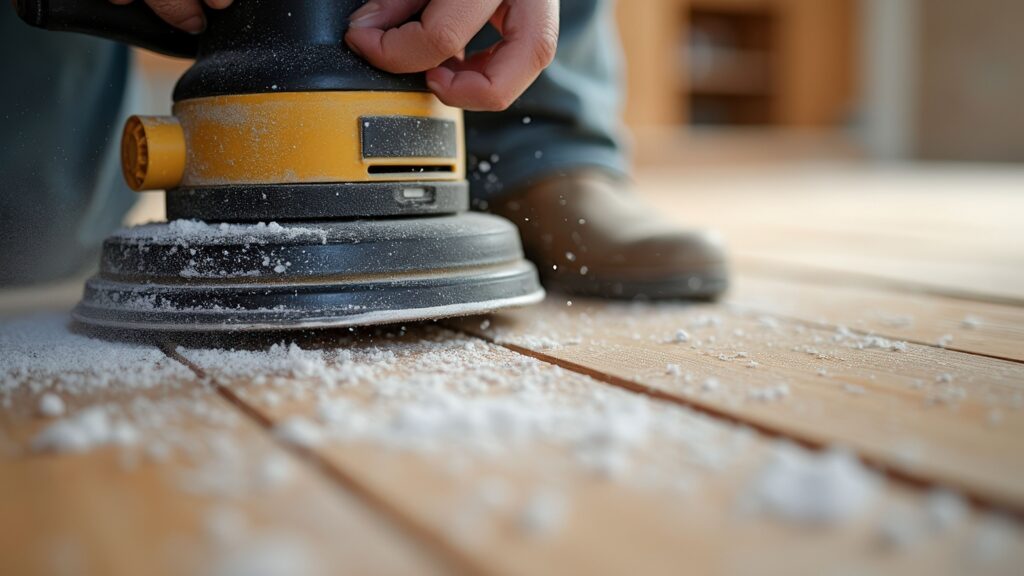
Hazard 1 — particulate (the sanding phase). Sanding aerosolizes wood dust, which settles into HVAC systems, cabinets, closets, soft furnishings, and clothing, and can stay airborne and resuspend for some time after the work stops [4]. Wood dust is classified by the International Agency for Research on Cancer (IARC) as a Group 1 carcinogen — but that classification rests on chronic occupational exposure: cabinetmakers and sawmill workers breathing dust daily for years, with cancer latencies averaging around four decades [5]. A homeowner exposed during a single project is in a very different dose regime. The practical homeowner concern is short-term respiratory irritation and the cleanup of dust that spread further than expected, not the occupational cancer endpoint.

“Nobody warned us about the dust. It was everywhere — in the cabinets, the closets, our clothes. We have a newborn.” — parenting forum

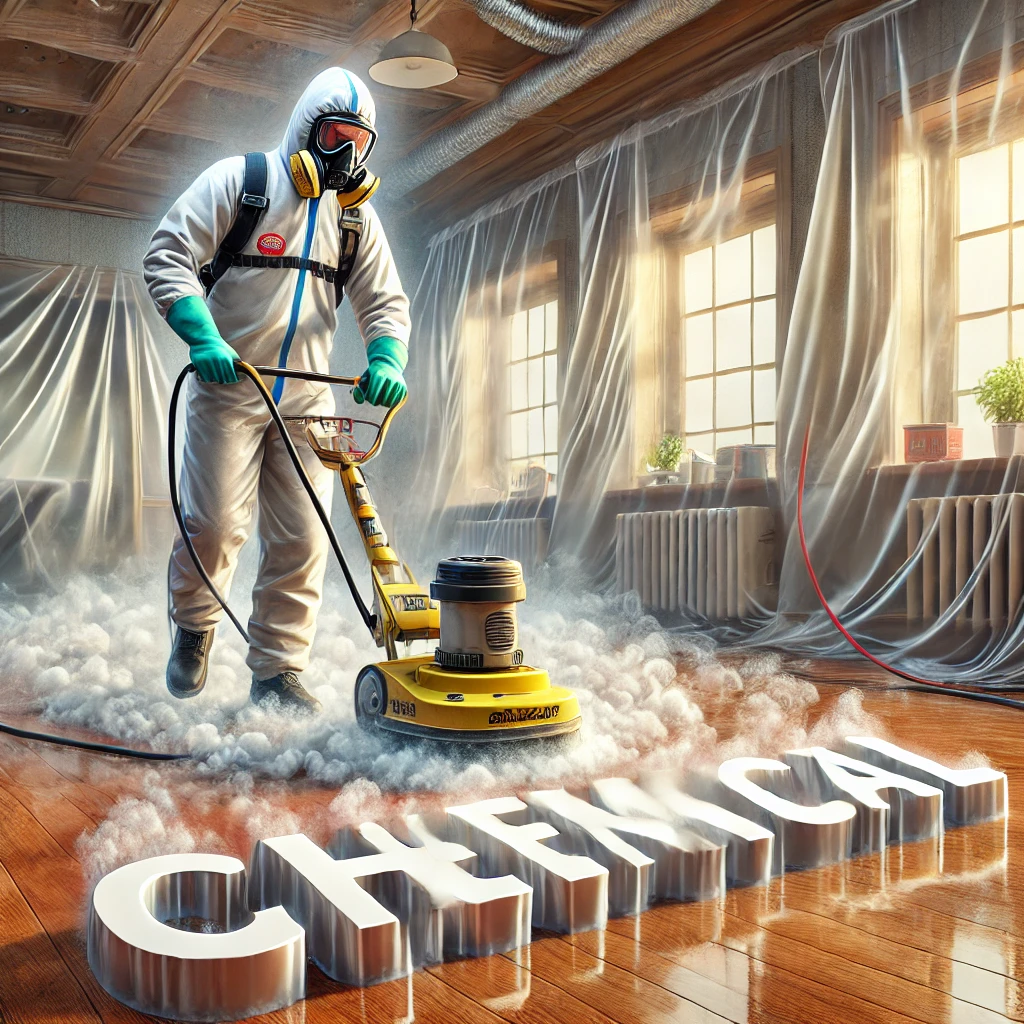
Hazard 2 — gas-phase VOCs (the finishing phase). As a finish cures, it releases volatile organic compounds (VOCs) and, depending on the product, formaldehyde and other aldehydes [6]. The solvent VOCs in oil-based products are largely aromatic compounds such as toluene and xylene; some strippers and prep products also contain N-methyl-2-pyrrolidone (NMP), a compound absorbed mainly through skin rather than the nose [12][14]. Emission is highest right after application and then decays — but the tail is long. Oil-based and acid-cured finishes keep emitting at low, sub-odor levels for weeks to months after the smell is gone [6][7]. This is the hazard your nose is least equipped to track, because it’s the one that fades from perception first and from the air last.

Two hazards, two clocks. The dust is mostly a during-and-just-after-sanding problem you manage with containment and cleanup. The VOCs are an after-finishing problem that outlasts the smell.

VOC content by finish type (the label-reading table)

How much a finish off-gasses — and for how long — depends heavily on what kind it is. Water-based products generally start lower and clear faster; oil-based, moisture-cure, and Swedish/acid-cured products carry far higher solvent loads and, in two cases, specific chemistry worth understanding.

Finish typeTypical VOC content (g/L)What to know
Hardwax-oil / penetrating oil~0–50 g/L (Rubio ~0; Osmo ~50)Lowest VOC of the common options; natural oils still emit some aldehydes as they cure [7]
Water-based polyurethane~100–275 g/L (pro products often ≤150)Low VOC of the film finishes; cures faster; shorter off-gas tail [7]
Oil-based polyurethane~350–500+ g/LSolvent-borne (toluene/xylene); high VOC; weeks-long off-gas tail [7][12]
Moisture-cure urethane~550 g/L; contains isocyanatesHighest-hazard sensitizer chemistry; professionally applied [8]
Swedish / acid-cured (conversion varnish)~550–700+ g/L; formaldehyde-releasingHighest formaldehyde emissions; the longest tail of the group [7][9]

Figures are typical ranges from manufacturer safety data sheets (e.g., Bona, Minwax, Rubio, Osmo); specific products vary — read the SDS for the product used on your floor.

The number to notice here is the spread: a water-based product can carry under a tenth of the solvent load of an acid-cured one. But the g/L figure is only part of the story — it measures solvent content, not the specific compounds (formaldehyde, isocyanates) that matter most for some of these finishes. More on that below.

How long do polyurethane fumes last? (reoccupancy timeline)

There is no single answer, because “done” has three meanings — and they happen weeks apart. “Smell gone” comes first (days). “Cured” comes next (the contractor’s milestone — a hardness claim about when the finish can take furniture and rugs, not a statement about the air). “Air back to baseline” comes last, and it’s the one that matters for breathing.

Finish typeSmell gone (approx)Cured (mechanical)Air toward baseline
Hardwax-oil / penetrating oil2–7 days5–21 days1–3 weeks
Water-based polyurethane1–3 days7–14 daysdays to ~2 weeks
Oil-based polyurethane5–14 days~30 days3–6 weeks [7]
Moisture-cure urethane1–3 weeks~30 days3–6 weeks
Swedish / acid-cured1–4 weeks30–90 daysweeks to ~6 months (formaldehyde) [9]

Source: manufacturer SDS data (Bona, Minwax, Rubio, Osmo) and trade-source consensus for acid-cured timelines [7][9]. Ranges are wide because temperature, humidity, ventilation, and how much product was applied all change the rate.

Notice that for every finish, “air toward baseline” lands after “smell gone” — usually well after. With an acid-cured floor, the smell can be gone in a couple of weeks while formaldehyde continues emitting at low levels for months. This is the gap that catches people: the contractor’s “cured” milestone is real, but it’s a mechanical milestone — when you can move furniture back — not an air-quality one.

Why the ranges are so wide is itself useful information. Off-gassing speeds up in warm, well-ventilated conditions and slows in cold, sealed ones. Airing the room out genuinely helps — opening windows and running fans both dilutes the air and pulls more of the residual out of the film faster. But it lowers the curve; it doesn’t skip the tail, and the moment you close the house up the slow emission can re-accumulate [6]. This matters in New England, where a finish applied in a closed-up winter house off-gasses slowly and stays trapped without ventilation. Because the variables stack — finish type, square footage, temperature, airflow, ventilation habits — no chart can tell you the date your specific home is clear. That’s the case for measuring rather than estimating.

If you’d rather have a number than a timeline estimate, here’s how we test the air for the specific compounds a refinishing job leaves behind.

“How do I know when it’s actually safe and not just ‘probably fine’?” — Reddit, r/HomeImprovement

“Low-VOC” does not mean “low-hazard”

“Low-VOC” is a regulatory label about solvent content — it does not tell you the product is free of the specific compounds that matter most. A finish can be low-VOC on paper and still off-gas formaldehyde or contain a sensitizer.

The VOC number on a can refers to grams of volatile organic compounds per liter, a metric originally aimed at outdoor smog formation. It’s a useful relative gauge — water-based really is lower than oil-based — but it says nothing about two specific compounds:

  • Formaldehyde. Swedish and acid-cured (conversion varnish) finishes are formaldehyde-releasing by chemistry. A product can meet a low-VOC threshold and still emit formaldehyde as it cures [9].
  • Isocyanates. Moisture-cure urethanes and some oil-based hardeners contain or release isocyanates. Isocyanates are sensitizers: the first exposures may cause no obvious reaction, but once a person’s immune system becomes sensitized, later exposures — even far below occupational limits — can trigger an asthma-type response, and that sensitization doesn’t reverse [8][10]. It’s effectively a one-way switch. The documented sensitization data come from workers with repeated, sustained exposure, not from a single home project. But because the switch is one-way, it’s a hazard worth understanding rather than dismissing.

Here’s the part that trips up the careful homeowner: a consumer “air quality” or TVOC meter won’t flag either of these. Inexpensive meters report a single, uncalibrated total-VOC number; they cannot identify individual compounds and miss formaldehyde and isocyanates entirely [11]. So “I bought a meter and it reads low” is not the reassurance it feels like — it’s a number from a tool that isn’t measuring the things you’d most want to know about.

“Floor guy told us water-based has no VOCs at all. That can’t be right, can it?” — Reddit

It isn’t right. Lower, often substantially — but “no VOCs” overstates it, and the g/L figure was never measuring the formaldehyde or isocyanate question to begin with.

Symptoms to watch for, by body system

The most commonly reported reactions during and after a refinishing job are irritation-type symptoms — eyes, airway, head — that often track with how much time you spend in the space. They’re worth noticing not because every symptom signals a problem, but because a symptom that eases when you leave the house and returns when you come back is a useful signal that the air, not you, is the variable.

Body systemReported symptomsAssociated exposure
Eyes / mucous membranesBurning, watering, irritationFormaldehyde, aldehydes, VOCs [4][6]
RespiratoryCough, wheeze, throat irritation, asthma flare, chest tightnessVOCs, isocyanates, wood/lead dust [4][8]
NeurologicalHeadache, dizziness, nausea, fatigue, trouble concentratingTotal VOCs, solvents [6]
SkinDermatitis, rash, sensitizationIsocyanates, solvents [8]
Immune / systemicSensitization (one-way), allergic-type responseIsocyanates [8][10]

These irritation-type symptoms are the everyday homeowner experience, and they typically ease as the air clears and ventilation continues. They sit at the opposite end of the dose scale from the long-term entries you’ll find in source material: chronic, high-dose occupational exposure to formaldehyde and wood dust carries documented cancer associations (IARC Group 1) [5][9]. Those findings describe years of daily industrial exposure, not a single home project, and we include them for completeness rather than as a description of a homeowner’s risk. The practical question is the table above — and whether those symptoms resolve as the air clears.

“The contractor said it’d be fine in 24 hours. Five days later my eyes still burn when I walk in. What did we do wrong?” — Reddit, r/HomeImprovement

Often the answer is “nothing wrong” — the 24-hour figure was about the finish being dry to walk on, not about the air being clear to breathe. Two different questions, covered next.

Babies, pregnancy, and pets: the most sensitive occupants

Infants, pregnant people, and pets can react at exposure levels that don’t bother a healthy adult — and they often can’t tell you they’re reacting. If your household includes any of them, the gap between “smell gone” and “air clear” deserves more caution, not less.

Infants breathe more air per pound of body weight than adults and spend time low to the floor, closer to where heavier vapors concentrate. Many parents only connect the dots after the fact:

“We slept at my mom’s for two nights then moved back. My toddler woke up coughing every night for a week. Never connected it to the floors until later.” — parenting forum

During pregnancy, heightened sensitivity to odors and irritants is common, and the instinct that “it doesn’t feel fine” even when others say it is can be worth trusting as a prompt to ventilate longer or get a measurement:

“I’m 7 months pregnant and the smell from the polyurethane is making me nauseous. Everyone says it’s fine but it doesn’t feel fine.” — pregnancy forum

Pets — and birds especially — are more sensitive to airborne irritants than people. A bird’s lung is built differently from ours: air flows through it in one direction across a dense network of fine air capillaries, making gas exchange extraordinarily efficient. That same efficiency means a bird draws proportionally more of whatever is in the air into close contact with its bloodstream, which is why birds react to fumes at levels people tolerate. If you keep a bird, treat the off-gassing window as a real consideration in where the cage lives. (For more on how indoor air affects animals, see our guide to indoor air quality and pet health.)

None of this means a vulnerable household can’t refinish floors. It means the reoccupancy decision benefits from data rather than a guess — extend ventilation, keep the most sensitive occupants out of the freshly finished space longer, and consider measuring before you move everyone back in.

Sanding old floors: the lead dust question (pre-1978 homes)

If your home was built before 1978, sanding can aerosolize lead from old paint or stain layers — a real hazard that calls for a lead-certified contractor rather than a homeowner with a rented sander. This is the one part of a refinishing job where the right move is to hire specifically for it.

Lead-based paint was common in older housing — roughly 87% of homes built before 1940 and about 24% built between 1960 and 1978 contain it [12]. Sanding floors finished or painted in that era can put lead-laden dust into the air and onto every surface it settles on. Because lead is especially harmful to young children and during pregnancy, the EPA’s Renovation, Repair and Painting (RRP) Rule requires that work disturbing painted surfaces in pre-1978 homes be performed by EPA RRP-certified renovators trained in lead-safe containment and cleanup [13].

To be clear about scope: this is not something IndoorDoctor performs. We’re an indoor air quality testing company, not a lead-abatement or clearance firm. If your home predates 1978, hire an EPA RRP-certified contractor for the sanding, and confirm certification before the work starts. Our role is what comes after — measuring the VOCs and formaldehyde from the finishing phase so you know when the air is back toward baseline.

The diligent-homeowner trap

The homeowners most likely to be caught off guard are the careful ones — because every responsible step produces a feeling of safety rather than a measurement. It’s worth naming directly, because the pattern is so easy to fall into.

Walk through it:

  • You aired it out — opened the windows, ran fans. That’s the right move, and it feels responsible. But it didn’t tell you the level.
  • You waited the time the contractor said. Patient and reasonable — but that timeline was about the finish hardening, not the air clearing.
  • You bought low-VOC. Conscientious — but low-VOC isn’t low-hazard, and the label never measured the formaldehyde or isocyanate question.
  • You noticed the smell fade. Reassuring — but that’s olfactory adaptation plus sub-odor-threshold chemistry, not an all-clear.

Every one of those is a feeling of resolution, and not one of them is a measurement. That’s not a criticism — it’s the structure of the situation. The signals available from inside the room all point toward “probably fine,” and none of them is actually checking the air. The only thing that converts a feeling into a fact is measuring it.

“Is there a way to actually test the air after refinishing? I don’t trust ‘it smells fine.'” — homeowner forum

Yes — and that’s the point of the section that follows.

How to actually know your air is safe: testing

Professional air testing replaces “it smells fine” with specific numbers for the specific compounds — and an expert to tell you what they mean for your home. This is the gap between a feeling and a fact, and it’s exactly what we do.

Here’s the difference between a measurement and a guess. A consumer TVOC meter gives you one uncalibrated number and can’t identify what it’s reading [11]. Professional testing uses thermal-desorption sampling analyzed by gas chromatography–mass spectrometry (GC-MS) at an accredited lab, which identifies and quantifies specific compounds — VOCs and formaldehyde — rather than lumping everything into a single reading. After a floor refinishing job, those are the compounds worth knowing about.

IndoorDoctor is a testing-only company — we don’t sell remediation. That matters here: because we have nothing to fix, we have no incentive to find a problem that isn’t there or to talk you out of one that is. We measure, we report the actual levels using severity-neutral language (“elevated levels detected,” contextualized to your home and who lives in it), and we walk you through what it means on a live Zoom expert consultation with a credentialed specialist. You get answers, not just data.

If you’re in New England (MA, NH, CT, RI, ME), we can come to you. Across more than 30,000 inspections since 2009, we’ve measured indoor air in every kind of home, and post-renovation air quality is one of the most common reasons people call.

BOOK AN ASSESSMENT — Schedule an indoor air quality assessment with a credentialed IndoorDoctor specialist, including a live Zoom consultation to interpret your results. Contact us → or learn more about our indoor air quality testing.

If you’re outside New England — or you’d rather not wait for a scheduled visit — you can measure the same compounds yourself with expert guidance. The IndoorDoctor On Demand Chemical Testing Package ($499) ships professional-grade sampling equipment to your door, walks you through collecting the samples on a live Zoom call, runs the analysis at an accredited lab, and includes a follow-up Zoom consultation to interpret the report. It tests for VOCs, formaldehyde, and other chemical sources — the panel that’s relevant after a refinishing job. It’s testing done do-it-with-us, not do-it-yourself.

One scope note, plainly stated: the Chemical Testing Package measures VOCs and formaldehyde. Isocyanates, discussed above as a finish hazard, require a separate sampling method — so if a moisture-cure or spray-applied product is your specific concern, ask your specialist about the right panel during your consultation.

For related reading, see our guides on VOCs and headacheshousehold dust and particulate matter, and spray foam off-gassing — which shares the same isocyanate chemistry as some floor hardeners.

Frequently asked questions

How long do polyurethane fumes last?
The smell usually fades within days, but low-level off-gassing continues longer — roughly 3–6 weeks for oil-based polyurethane and days to about two weeks for water-based [7]. The odor leaving is not the same as the air returning to baseline; the only way to confirm the latter is to measure it.

Is it safe to sleep in the house after refinishing floors?
That depends on the finish, the ventilation, and who’s sleeping there — and “I can’t smell it” is not a reliable test, because your nose adapts within minutes and health-relevant levels can sit below the odor threshold [1][2]. If you have infants, anyone pregnant, or pets, the cautious move is to extend ventilation and, ideally, measure before moving everyone back into the finished space.

Can refinishing floors make you sick?
Floor refinishing can cause irritation-type symptoms — burning eyes, cough, headache, nausea — from VOCs, formaldehyde, and dust, particularly during and shortly after the work [4][6]. These typically ease as the air clears and ventilation continues. Symptoms that improve when you leave the house and return when you come back are a signal worth measuring.

Is polyurethane toxic after it dries?
“Dry to the touch” is not the same as “done off-gassing.” Cured polyurethane keeps emitting VOCs at declining, often sub-odor levels for weeks, with oil-based lasting longer than water-based [6][7]. The film being hard enough to walk on is a mechanical milestone, not an air-quality one.

How do I know when the air is safe after refinishing?
You measure it. A professional VOC and formaldehyde test using thermal-desorption and GC-MS analysis identifies the specific compounds and their levels — something a consumer TVOC meter cannot do [11]. IndoorDoctor offers in-person assessments in New England and a nationwide Chemical Testing Package with live Zoom guidance.

Is floor refinishing safe during pregnancy?
Many people are more sensitive to odors and irritants during pregnancy, and the irritation-type symptoms above can be more pronounced [4]. There’s no need to assume the worst, but extending ventilation, staying out of the freshly finished space longer, and measuring before reoccupying are all reasonable precautions. Discuss specifics with your healthcare provider.

Are floor finish fumes dangerous to pets or birds?
Pets — and birds especially — are more sensitive to airborne irritants than people, because of how efficiently their respiratory systems exchange air. Keep birds and other pets out of the freshly finished area during the off-gassing window, and see our guide to indoor air quality and pet health for more.

Does water-based polyurethane have VOCs?
Yes — typically around 100–275 g/L, substantially lower than oil-based (350–500+ g/L), but not zero [7]. “Low-VOC” also doesn’t mean free of formaldehyde or other specific compounds, and the VOC figure on the can doesn’t measure those at all.


Resources: statistics, glossary, and references

Relevant Statistics

StatisticValueSource
Formaldehyde sensory-irritation / odor onset (when many people notice it)~80–100 ppb (0.08–0.1 ppm)WHO IAQ 30-min guideline; Golden 2011 [4]
Formaldehyde chronic health-based reference level (OEHHA chronic REL)9 µg/m³ (≈7 ppb)CA OEHHA [2]
Formaldehyde chronic exposure benchmark (ATSDR chronic MRL)0.003 ppm (~3 ppb)ATSDR [3]
Olfactory adaptation (perceived odor drop on steady exposure)~50%+ within minutesOlfactory-adaptation literature [1]
Oil-based polyurethane VOC content~350–500+ g/LManufacturer SDS (e.g., Minwax) [7][12]
Water-based polyurethane VOC content~100–275 g/L (pro often ≤150)Manufacturer SDS (e.g., Bona) [7]
Swedish / acid-cured finish VOC content~550–700+ g/L; formaldehyde-releasingIndustry SDS / trade sources [9]
Oil-based poly — air toward baseline3–6 weeksManufacturer SDS / trade consensus [7]
Swedish / acid-cured — formaldehyde off-gas windowWeeks to ~6 monthsTrade-source consensus (e.g., Glitsa) [9]
Wood dust carcinogenicity (chronic occupational exposure; ~40-yr latency)IARC Group 1IARC / NTP [5]
Formaldehyde carcinogenicity (chronic occupational exposure)IARC Group 1IARC Monographs 88/100F [9]
Pre-1940 homes containing lead paint~87%EPA [12]
Homes built 1960–1978 containing lead paint~24%EPA [12]
EPA RRP Rule applicabilityPre-1978 homes; certified renovators requiredEPA RRP Rule [13]

Occupational/IARC figures describe chronic, high-dose exposure (years of daily industrial contact), not a single home project. Included for completeness — see the article body for dose context.

↑ Back to top


Glossary

  • Acid-cured finish (Swedish finish / conversion varnish) — A durable floor finish that cures through an acid-catalyzed reaction and releases formaldehyde as it cures. Carries the highest formaldehyde emissions and the longest off-gassing tail of the common finish types.
  • Curing — The chemical hardening of a finish to its final durability, allowing furniture and rugs to return. A mechanical milestone — distinct from when airborne emissions return to baseline.
  • Formaldehyde — A volatile compound emitted by some finishes, especially acid-cured/Swedish products. Noticeable by smell only at concentrations well above its chronic health-based reference levels, which is why odor is a poor safety gauge for it.
  • GC-MS (gas chromatography–mass spectrometry) — A laboratory method that separates and identifies individual chemical compounds in an air sample, quantifying specific VOCs and formaldehyde rather than reporting a single combined number.
  • Isocyanate — A reactive compound in moisture-cure urethanes and some hardeners. A sensitizer: once a person becomes sensitized, later exposures can trigger asthma-type reactions even at low levels, and the sensitization does not reverse. Requires a separate sampling method from standard VOC testing.
  • NMP (N-methyl-2-pyrrolidone) — A low-volatility solvent found in some finish strippers and prep products. Absorbed mainly through the skin rather than inhaled, so odor offers little warning; flagged by the EPA as a reproductive/developmental concern.
  • Off-gassing — The release of volatile compounds from a curing finish into the air. Highest immediately after application, then decays over days to months depending on the finish and conditions.
  • Olfactory adaptation (olfactory fatigue) — The normal desensitization of smell receptors to a steady odor, reducing perceived intensity within minutes even when the airborne concentration is unchanged.
  • Reoccupancy — Returning to live in a space after a renovation. The point worth basing this on is when the air is back toward baseline — not when the smell fades or the finish cures.
  • RRP Rule (EPA Renovation, Repair and Painting) — A federal rule requiring certified, lead-safe work practices when disturbing painted surfaces in pre-1978 housing.
  • Toluene / xylene — Aromatic solvent VOCs that carry the resin in oil-based finishes and evaporate as the film cures; the main drivers of the “high/dizzy” feeling near a fresh oil-based finish.
  • TVOC (total volatile organic compounds) — A single combined measure of airborne VOCs. Consumer TVOC meters report one uncalibrated number and cannot identify individual compounds or detect formaldehyde and isocyanates.
  • VOC (volatile organic compound) — Carbon-based chemicals that evaporate into air at room temperature, emitted by finishes and solvents. Measured in grams per liter (g/L) on product labels — a solvent-content figure, not a full hazard profile.

↑ Back to top


References & Citations

#SourceWhat it supports
1Olfactory adaptation / fatigue research (sensory-science literature)Perceived odor intensity drops ~50%+ within minutes of steady exposure
2CA OEHHA — Formaldehyde reference exposure levelsChronic REL 9 µg/m³ (≈7 ppb)
3ATSDR — Toxicological Profile for FormaldehydeChronic MRL (0.003 ppm); irritation context
4WHO IAQ 30-min guideline / Golden 2011 (irritation + cancer exposure limit)Formaldehyde sensory-irritation onset ~80–100 ppb
5IARC / NTP — Wood Dust (Report on Carcinogens)Wood dust = Group 1 carcinogen (chronic occupational; ~40-yr latency)
6EPA — Volatile Organic Compounds’ Impact on Indoor Air QualityVOC off-gassing curve; symptoms; temperature/ventilation effects
7Manufacturer technical data sheets (Bona, Minwax, Rubio, Osmo)VOC content by finish type; reoccupancy/off-gas timelines
8OSHA — Isocyanates: Health EffectsIsocyanate sensitization; occupational asthma; no safe level once sensitized
9IARC Monographs 88/100F — Formaldehyde / acid-cured finish emissionsFormaldehyde Group 1; formaldehyde-releasing finish off-gassing
10NIOSH — Isocyanates & occupational asthmaOne-way sensitization mechanism
11EPA — Indoor air quality monitors (consumer devices)Consumer TVOC meters: single uncalibrated number; miss formaldehyde/isocyanates
12EPA — Protect Your Family from Sources of LeadLead-paint prevalence by build year; oil-based solvent VOCs context
13EPA — Renovation, Repair and Painting (RRP) RuleCertified-renovator requirement for pre-1978 homes
14EPA — Risk management for N-methylpyrrolidone (NMP)NMP in paint/finish strippers; dermal absorption; reproductive concern

↑ Back to top

Learn More

Blog Form

This field is for validation purposes and should be left unchanged.
This field is hidden when viewing the form
By checking this box you agree to receive SMS communications from IndoorDoctor. Reply stop to opt-out at any time.
I agree to the terms and conditions described in the Privacy Policy(Required)